Showing posts with label Panawagan. Show all posts

Tuesday, April 27, 2010

Preying on the Weak

Every once in a while, our version of reality blurs and we get a glimpse of what its like in the 'real' world.

J of thenutbox recounts the nightmarish ordeal his mother went through, allegedly, at the hands of some police officers stationed in Talipapa, Novachiles, Quezon City.

Last April 14, my mother went to visit a friend named Janet who lives in a slum area in Tandang Sora, Quezon City. That friend owes my mother some thousands, which my mother decided to collect because she needs money for her medication. My mother was accompanied by an old friend, Maximo Gabriel.


At around twelve noon, just when my mother and Gabriel were about to leave Janet’s place, two plain-clothed policemen- one called Allan and another named Mar Palic- approached them, accusing them of drug possession. My mother and her friends aghastly denied this, and before the two cops could search them they showed their bags to the police officers and emptied their pockets to show that there was nothing incriminating inside. Still, the cops “invited” them for questioning. 

Read the rest here.

Its an extraordinary story. Most of us would never dream of such a thing ever happening. But these insects - they prey on the weak.

Tuesday, April 06, 2010

Calling on all Readers of Political Blogs

Dear All,

If you have a few minutes to spare, you might consider being a participant in Grace Mirandilla's research on political blogging. For details, see below. Cheers!

--------

A Call for Survey Respondents: Filipino Blogging and Political Participation Study

Good day! Do you read political blogs*? Can you spare 10 mins. to answer a survey? Then, please read on.

My name is Mary Grace P. Mirandilla, an independent researcher conducting a study on "blogging and political participation among Filipinos,” which is funded by the SIRCA** grant program of IDRC*** Canada. This research wants to look at (1) why Filipinos read political blogs; (2) how they participate in politics--both online and in the real world; and (3) whether and how political blogs affect their participation.

I’m looking for respondents to answer a survey that inquires about these research questions. If you want to participate, you must be Filipino, at least 18 yrs old, and read political blogs (or have read them at some point during the past year). It only takes 10-12 minutes to answer the survey, which will be administered via email.

If interested, please send me a PM or email me at mg(dot)mirandilla(at)gmail(dot)com. Rest assured that your identity and response will be kept confidential.

I hope to hear from you by April 15. Thank you very much.

Regards,
Grace Mirandilla

Thursday, January 28, 2010

UP Academic Congress: Beyond 2010 - Leadership for the Next Generation

February 1 to 5, 2010. 8am - 6pm, Malcolm Hall, UP Diliman

DAY 1 - February 1, 2010, Monday

8:30 AM Start of Registration Proper
9:30 AM Opening Ceremonies
9:30 – 9:45 AM Opening Remarks by Dean Marvic M.V.F. Leonen
9:45 – 10:00 AM Message from UP President Emerlinda R. Roman
10:00- 10:45 AM “What Truly Matters to Filipinos?” by Prof. Randolf S. David
10:45 – 12:00 AM Open Forum
12:00 – 1:30 PM Lunch Break
1:30 – 3:30 PM Session 1: Jobs and the Cost of Doing Business
3:45 – 5:45 PM Session 2: Debt and Deficits

DAY 2 - February 2, 2010, Tuesday

8:30 AM Registration Proper
9:00 – 11:00 AM Session 3: Political Economy of Mindanao
11:00 – 1:00 PM Lunch Break
1:00 – 3:00 PM Session 4: Health and Politics

DAY 3 - February 3, 2010, Wednesday

8:30 – 10:30 AM Session 5: Diaspora of Filipinos
10:30 – 12:30 PM Session 6: Property Reform and Related Issues
12:30 – 1:30 PM Lunch Break
1:30 – 3:30 PM Session 7: Urban Development and Housing
3:45 – 5:45 PM Session 8: Science and Technology

DAY 4 - February 4, 2010, Thursday

8:30 – 10:30 AM Session 9: Confronting Trade, Markets and Regulation
10:30 – 12:30 PM Session 10: Foreign Policy
12:30 – 1:00 PM Lunch Break
2:00 – 4:00 PM Session 11: Climate Change and DRR

DAY 5 - February 5, 2010, Friday

8:30 – 10:30 AM Session 12: Culture of Impunity
10:30 – 12:30 PM Session 13: Elections and How to Choose Leaders
12:30 – 1:00 PM Lunch Break
1:30 – 3:30 PM Session 14: Labor
3:45 – 4:45 PM Summary by the Chief Rapporteurs
4:45 PM Closing Remarks by UP Diliman Chancellor Sergio S. Cao
Session 15: Energy Security (Third week of February)

Monday, September 28, 2009

People in Charge: A Letter to the Filipino

It is perhaps part of our culture to have blind faith in many things, not least faith in two social forces that most shape our collective lives – god and government. This weekend has clearly demonstrated that our faith can only take us so far. God only helps those who help themselves. And government will only help itself unless pressured to do otherwise. We should perhaps take stock of what burden, what “charge,” we should place where appropriate. We cannot have blind faith that god will provide and succor. We cannot have blind faith that government will govern.

Of force majeure Ondoy, we have no control over. But we need not remain resigned to the caprice of nature and fate. Civilization tells the story of man’s battle to tame nature. All of science is a monument to this undertaking. For each difficulty posed by nature’s tyranny, humankind has dreamed of and fashioned solutions. Why can’t we? Typhoons, harbingers of disaster, come and go like the tide. Yet all these years, all these decades, we succumb blindly to fate. Fatalism is a condition that belongs to olden days. If there is progress, then there is no room for blind acceptance of what becomes of us.

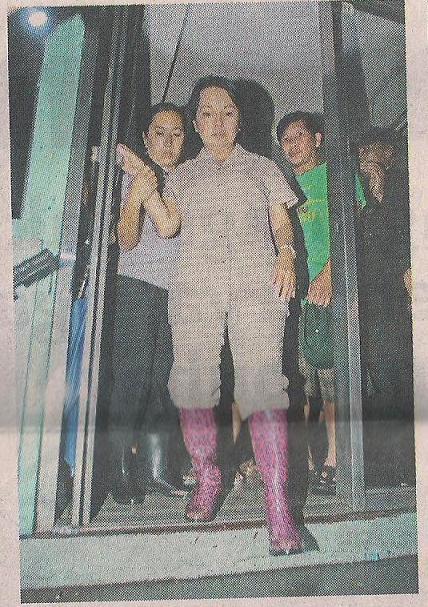
And government – oh government. As we see names and personalities play their roles before us on our TV screens, we ask ourselves where the make-believe ends and where reality begins. The President wades in water in her pink boots while her son searches and rescues booze in a liquor store. Our leaders, ourselves? I despair. Yet perhaps this statement is unfair. Government or no, we have seen stories of people who help themselves. There is heroism in grand scale committed by humble nobodies. There are unknown soldiers who have gone beyond the call of duty. There is that 18 year-old construction worker who has saved thirty lives only to lose his. There is that father who mourns the computer for which he scrimped and saved to gift his son. His house and all he owns buried in mud, he endeavors to go on.

And so, here we are. The people we put in charge, the people to whom we entrust our monies and our fate. There is so much we do not know, so many questions to ask about the nitty-gritty of governing. For now let us ask this question, where did it go, our P5 billion supposedly spent on “flood control projects” last year?

The people we put in charge, bearer of public monies and public trust. Our state of affairs need not perennially begin in helplessness and end in tragedy. In 2010, when we choose people to put in charge, let us have faith in ourselves - that we deserve so much more than we have been given. And if we believe we so deserve a rational, functioning and clean government, then so must we exact.

Volunteer Clean Up!

This is to inform everyone that the Loyola Schools, headed by the Office of Administrative Services (OAS), will go on its first trip tomorrow, 29 September, to help clean-up the houses of those who have been affected by the flood. There will be two volunteer groups, one will proceed to Dela Costa 5 in Montalban and the other in Ateneoville. The groups will meet at Xavier Hall for their expected departure at 8:00 am and to arrive back, hopefully, by 3:00 pm. Should there be anyone who might still be interested to join tomorrow's brigade, please send a text message to Ms. Lucia Chavez of OAS or you may email her at lchavez@ateneo.edu, to be able to include your names.

OAS will be bringing with them some cleaning aides but volunteers are encouraged to bring their own as well. Below are the following things needed:

1. shovel (only if you can)
2. detergent soap
3. scotch brite
4. cleaning brush
5. walis tingting
6. pail (timba) and/or tabo
7. rugs
8. please bring your own food and water to drink

Everyone is advised to wear shorts and slippers or perhaps, boots (bota).

The second round of visit will take place on the following day, 30 September. Volunteers from the faculty members and staff are being encouraged to join the clean-up brigade to be able to help our friends.

An update on tomorrow's trip will be given out before the day ends.

Ateneo Task Force Ondoy

The Ateneo is accepting donations, both in kind or in cash/check. The center
of relief operations is the Ateneo College Covered Courts. Most needed are
ready-to-eat food, canned goods, drinking water, clothes, mats, and blankets.
Those who wish to donate or volunteer for Ateneo Task Force Ondoy are welcome
to go to the College Covered Courts, where they will be directed, assisted,
and briefed.

For cash donations, direct deposits can be made to:
SIMBAHANG LINGKOD NG BAYAN (Account Name/Payee)
Bank of the Philippine Islands (Loyola-Katipunan Branch)
BPI Peso Checking Account Number: 3081-111-61
BPI Dollar Savings Account Number: 3084-0420-12
Checks may be addressed to Simbahang Lingkod Bayan as well. For GCASH users,
you may send your donations by typing: DONATE__<4-digit>_SLB and
send to 2992.

Operations start at 6AM daily, and deployment to the areas start at 1PM. Volunteers are welcome to help by signing up for three-hour shifts each, starting at 6AM ending at 12AM. For easier monitoring, people are highly encouraged to come at the start of the three-hour intervals. For volunteers, please wear comfortable working clothes. Bring umbrellas, jackets, extra shirts, and water. Please wear blue.

We are also consolidating a list of missing people and evacuation centers around
Metro Manila. Please visit and update http://ateneotaskforceondoy.misa.org.ph.
If you know people who are missing or who are at evacuation centers, please
add their names and contact information at the website. The site is currently
still down, but please check back in an hour or so. We are still finishing
uploading files into the site.

Just today, September 27, we were able to raise Php 83,000 in monetary donations
to aid the relief victims. 3,000 packs of relief goods have also been sent
to Upper Brangka Bliss.

For inquiries, please contact Gio Tingson at 0917/880-7427 or Kacci Morales
at 0927/981-8811.

Monday, July 27, 2009

Returning Gloria's Gaze

Video cameras will be our ‘weapons’ on the day of the SONA, said Metro Manila police director Chief Superintendent Roberto Rosales. What a bizarre turn of phrase, I thought. The police made similar proclamations before the multi-sectoral Anti-Conass mobilization last month. They were to install CCTV cams in Makati.

When authorities make these kinds of announcements, it doesn’t matter whether they’re true or not, whether they have actually installed cameras or not. It is enough that the police have made such an announcement. The threat or promise of the camera’s gaze will be enough to alter the behavior of the observed. It is designed to impose a subtle means of control.

The only way to resist the power of the observer’s gaze is to return it. So today, while we all know Gloria Arroyo will be lying through her teeth, let us all tune in and look right back at her. Watch the SONA, document, take pictures if you are on the field, webcast from your homes, make notes and write.

Tuesday, February 24, 2009

Myth-making in a Time of Fragmentation

As much as things unseen shape communities - the law, institutions, networks of friends and families, work and others - what holds a nation together is a common narrative. A story binding all in the mosaic of our country is comprised of common goals, struggles and heartaches. In each other we should see a reflection of ourselves. The taxi driver has essentially the same story as the teacher, the balut vendor, the politician, the accountant, the homeless, the call center agent.

As scholar and historian Benedict Anderson once said, we have to able to imagine a community first, before it becomes a reality. In this liquid soup of change, of shifting space and time it is often difficult to locate place and belonging. Allegiances are shifting, as the old crumbles all around us. In the hyperspeed of today, of reflexive reality unfolding in real-time, it is often difficult to find quiet to reflect. This is why we look to the past to remind ourselves of how we got here - amidst the uncertainty of change. We celebrate our nation's symbols - the flag, the national anthem, the innocuous sampaguita, to draw from them the magic qualities of what it means to be Filipino. From the holy days we celebrate, we draw a thread to sew into the story of the private, individual lives we live.

Today we celebrate one of the great mythologies of the Filipino - the People Power revolution. I was too young to remember anything substantive. Over twenty years later, I look to the accounts of elders, Wikipedia and YouTube to derive meaning from such a landmark in our commonstory.

Far from a historical relic, EDSA is real and relevant. It is the core artery of our metropolis. It is the channel from which we all converge and diverge on our way to work, our loves and enemies, our homes. It is the avenue not only of resistance, but the avenue of means, of tragedy, of relief and disparity.

EDSA is at the heart of this country's soul. It pulses the beat of the networks of families, friends, colleagues, leaders and followers we have all created. We look to EDSA, we look at ourselves.

But what of those who do not physically encounter it? What of the millions who live in the hinterlands? What of the millions abroad? For them there is only the spirit. In which ways does the spirit continue to live? I believe it is this generation's challenge to answer this question. For those who may question the value of even going through such an exercise, I have this simple answer. While People Power may vary in meaning for all of us, while it may mean what we want it to mean, while we may construct People Power to suit different purposes - no one can deny that it is, above all, a story of liberation.

In the cool of our office cubicles, on the blistering heat of sub-standard cement roads, in the sanctuary of our homes, we ask ourselves - who does not want to be free? Free from drudgery, isolation, debt and a soaring cost of living. Free from noise and pollution. Free from dogmatic religion. Free to go from point A to point B with ease of transportation. Free to look at the expanse of our city, our village our towns and see beauty instead of ugliness. Freedom from food shortage and poverty. Freedom to sleep at night without anxiety.

People Power is our commonstory. It is our magic talisman to reclaim freedom to live as we will, to reclaim this country for ourselves. We must cling to it with all our might, our ticket to redemption, our memory waiting to become reality. Power to the people.

Tuesday, February 17, 2009

The World Economic Crisis and Asia

A Public Lecture Sponsored by
Department of Economics, Department of Political Science, and
Action for Economic Reforms

"The World Economic Crisis and Asia"

by:

Dr. Jomo Kwame Sundaram

Assistant Secretary-General for Economic Development,
Department of Economic and Social Affairs, United Nations
and
Member, United Nations Commission of Experts on Reforms
of the International Monetary and Financial System


23 February 2009, Monday
4:30-6:00 PM

Faura AVR
Ateneo de Manila Loyola Heights Campus

Thursday, January 01, 2009

Let's Talk About Golf

A live Rock Ed Radio forum on violence on or off the golf course and how we are - in general.

Panelists are peace advocate Bobby Garcia, PLM President Adel Tamano, AdMU Prof and Ladlad Party Chair Danton Remoto.

Discussion moderated by Lourd de Veyra and Gang Badoy
Music Performance by RADIOACTIVE SAGO PROJECT.

Friday, 2 Jan 2009.
Route 196
Katipunan Rd, Blue Ridge Stretch
near Shell gas station corner past from White Plains

Don't miss this explosive night.

Wednesday, November 12, 2008

The Precariousness of Hope

Change. We can all agree that we can probably easily quantify what change would mean for all of us. For me it means not feeling so powerless, not feeling like a victim of everyone and everything. It means being able to live decently and fairly. It means living in a society whose leaders do not make it their official business to rob everyone blind. Is that too much to ask?

From the periphery of our collective mentality, we all know this government is corrupt. This society is corrupt. Our values are corrupt. Most of us know this, and in our acquiescence of the fact we are complicit in keeping the monster within alive and well. Over a century ago, Rizal had a name for it. Over the decades the cancer has metastasized a dozen-fold, eating away at everyone and everything. Is there anything healthy left?

Change. It has to start somewhere. Powerlessness means not knowing how or when or where. Powerlessness means not being able to picture any other alternative. The reality of now is resolute and etched in stone.

Ignorance is truly bliss. Most everyone goes about the business of their lives not knowing the extent to which greed rules this country. The most rapacious of criminals reside in the halls of power. There are no laws. There is no justice. Has everyone gone blind or have we simply grown inured to this fact? Numbed by scandal after scandal after scandal?

I am twenty-eight years old. Privileged to have been granted the best education this country can offer. In me resides the promise of the generations who came before me. I am too young to be jaded. Let me see a glimmer of something. Let me see.

Tuesday, October 07, 2008

Speak for the Subaltern


It's a short clip, but devastating nonetheless. In less than sixty seconds the BBC comedy show Harry & Paul normalises, even trivialises the hardships, indignity and abuses suffered by many Filipina migrants abroad.Domestic helpers have rights too. Speak for the subaltern. Sign this petition.

Wednesday, September 03, 2008

Sex and Politics: An Appeal to Reason

Why is there a need for a comprehensive legislation on population and reproductive health?

The Philippines’ policy on population and reproductive health (including family planning) has always been dependent on the incumbent. The late President Ferdinand Marcos instituted various commendable policies on said issues. However, President Corazon Aquino’s ambiguous stand on the role of family planning adversely affected the implementation of the national family planning program by the Commission on Population (POPCOM) and its partners.

Former President Fidel V. Ramos’ administration, in contrast, saw a strong support for family planning initiatives as it was sought in the context of sustainable development. When Joseph Estrada became President, enlightened officials in his Cabinet aggressively pursued and implemented family planning programs albeit the lack of any official pronouncement on population and family planning.

Estrada was replaced by President Gloria Macapagal-Arroyo, whose stand on the matter of population has been flip-flopping. She once acknowledged the need to reduce the country’s population growth rate to 1.9 percent, only to say in another statement that she is leaving the matter to local government units.

Relegating the responsibility of crafting and implementing policy interventions on population, reproductive health at the local level is not a viable option. This would lead to unsustainable and uneven programs across LGUs because of the relatively short term of LGU officials (3 years), disparities in internal revenue allotment (IRA), and the local official’s priorities, among others.

A number of progressive local government units like Aurora, Ifugao, Marikina, and Davao City have already put in place family planning and reproductive health policies and programs in their respective areas. But what to do with a city as big as Manila, where any form of information and services related to family planning has been banned?

Unless a comprehensive national legislation on population and reproductive health is put in place, our people’s right to complete, accurate and comprehensible information, and comprehensive services on population and reproductive health will always be dependent on the whim of the powers that be.

What is wrong with the government’s recent natural family planning-only (NFP-only) policy?

Universal access to a constellation of methods in family planning utilizing a principle of voluntary choice is founded on the 1987 Philippine Constitution, which guarantees for every human person full respect for human rights (Sec. 11, Art. 2,). Moreover, the fundamental law of the land gives due cognizance to the particular needs of women for gender equality (Sec. 14, Art. 2); of the youth to enjoy protection of their physical, moral, spiritual, intellectual, and social well-being (Sec. 13, Art. 2); and of spouses to found a family in accordance with their religious convictions and the demands of responsible parenthood (Sec. 3:1, Art. 15).

A policy focusing on natural family planning alone actually goes against these Constitutional principles. The government’s Natural Family Planning-only (NFP-only) policy will isolate the majority of women who prefer modern and artificial methods. Focusing only on natural methods is disempowering and discriminatory to women as it deprives them of universal access to the whole range of family planning methods so that they can choose what is most appropriate for their bodies, in accordance with their beliefs.

International and local studies have established that natural methods are not for everyone. For example, the standard days method is effective only for women whose menstrual cycles fall between 26-32 days and requires the unfailing cooperation by the husband as the couple must abstain from sex for 12 consecutive days during the woman’s fertile period.

Various national surveys of the National Statistics Office have also revealed that Filipinos prefer modern family planning methods, with pills as the consistent no. 1 method of choice.

The government’s NFP-only policy will also reverse the gains in lowering fertility and slowing down population growth to propel national development. It is impossible to achieve the government’s 1.9 percent population growth rate target if other legally permissible and medically-safe family planning methods are disregarded.

If government is really concerned about women’s fear of side effects and complications, and the general acceptability of modern methods, then, it should put its resources to programs for educating people on the pros and cons of all methods, rather than a policy imposing only one method.

What hampers the establishment of a comprehensive legislated policy on population and reproductive health?

Some leaders of the Catholic hierarchy and lay organizations have vigorously opposed reproductive health, family planning and population initiatives. While these groups have the right to stand for their religious beliefs, as guaranteed by the Constitution, the situation becomes problematic when they threaten and coerce those who believe otherwise, as what has been happening come election time. During the 2004 elections and in the 2007 elections, members of the Catholic hierarchy and lay organizations have been known to campaign against candidates supportive of policies and programs on population, reproductive health, and family planning. This is highly inappropriate as these candidates, when elected into office, will have the responsibility of crafting policies and implementing programs that will benefit all Filipinos, whether Catholic or otherwise. Moreover, data from the 2003 NDHS show that only 2.4 percent of married women cite religion as their reason for not using contraception.

Sadly, there are also leaders in government who choose not to recognize that the country’s population and reproductive health situation really needs to be addressed as it has serious negative impacts on our development as a nation. By turning a blind eye on the situation, they are failing to concretely address the people’s needs.

Do the people want reproductive health and population policies and programs?

The results of the Pulse Asia Ulat ng Bayan surveys on Family Planning done in 2000, 2004 and 2007 indicate the people’s consistent clamor for a comprehensive national policy on reproductive health and family planning.

In particular, the March 2007 Ulat ng Bayan findings reveal the following:

  • Nine out of 10 Filipinos (92%) consider family planning important.
  • Nearly 8 out of 10 Filipinos (76%) believe in the importance of including family planning in a candidate’s program of action.
  • Three-quarters of the adult Filipino population (75%) will support candidates who are in favor of a government budget for family planning.
  • About 9 in 10 Filipinos (89%) think it is important that government provide budgetary support for modern methods of family planning including the pill, intra-uterine devices (IUD), condoms, ligation and vasectomy.
  • One in two Filipinos (50%) is of the opinion that rapid population growth hinders the country’s development
  • A larger proportion of Filipinos believe that the church (or religion) should not participate in the issue of what family planning methods couples should use (44% vs 33%).
The results of the 2004 elections have also proven that inclusion of reproductive health and family planning in a candidate’s platform of government is not a factor in losing, as all of the national and local candidates who carried these issues have gained a fresh mandate from their constituents.

Wednesday, August 20, 2008

Progressives

OUT OF THE LIST: Assessing the power of progressive party-lists in the context of oligarchic Philippine politics

Brought to you by:

Buklod CSSP: The premier leadership and service giving formation in the College of Social Sciences and Philosophy

Guest Speakers:

Mrs. Loreta Rosales (Akbayan)

Mr. Ramon Casiple (Institute of Political and Electoral Reform)

Dr. Felix Muga (Ateneo Math Department)

Mr. Joel Rocamora (Institute for Popular Democracy)


Claro M. Recto Hall
University of the Philippines
August 22, 2008
1:00- 4:00 p.m.

Wednesday, July 09, 2008

A Forum on the Brand of Political Leadership in Today's Nation-Building

Ateneo de Manila University-School of Government
and the
Ateneo de Manila University-Department of Political Science

would like to invite you to:

A Forum on the Brand of Political Leadership in Today's Nation-Building

featuring talks by our most inspiring Local Government Leaders today:

Gov. Eddie Panlilio (Pampanga)
Gov. Grace Padaca (Isabela)
Mayor Jesse Robredo (Naga City)
Mayor Sonia Lorenzo (San Isidro, Nueva Ecija)

July 30,2008 (Wednesday)
4:30 p.m. to 6:30 p.m.
Leong Hall, Ground Floor, Ricardo and Rosita Leong Center for Chinese Studies,
Ateneo de Manila University, Loyola Heights, Quezon City, MM

Seats are limited. Please confirm your attendance to this event by sending at email to Kai Pastores at kai.pastores@yahoo.com or you can contact us at (02) 426-5657.

musiKolokya

The UNIVERSITY STUDENT COUNCIL
COMMITTEE FOR CULTURE AND THE ARTS

in cooperation with the

Department of Musicology
UP COLLEGE OF MUSIC

and the

CMu STUDENT COUNCIL

musiKolokya: Musical politicking, political musicking: a forum on the interaction of music and politics

Speakers:

Jonas Baes, Ph.D.
Raul Navarro, Ph.D.
and
Noel Cabangon

Thursday, July 10, 2008
4:00 pm
Museum of Instruments
UP College of Music

The forum explores the impact of politics on musical creation and reproduction and, conversely, the role of music in the political arena. Of particular interest will be the function of music as a tool of social persuasion, transformation or dissidence.

Dr. Jonas U. Baes is a composer, ethnomusicologist and activist who has written on the Iraya-Mangyan of Mindoro and issues of hegemony and cultural politics. He currently chairs the Department of Composition and Music Theory.

Dr. Raul C. Navarro is chair of the Department of Conducting and author of Kolonyal na patakaran at ang nagbabagong kamalayang Filipino: Musika sa publikong paaralan sa Pilipinas, 1898-1935. He has also lectured on the music of the Martial Law era.

Noel Cabangon is an acclaimed singer, songwriter and musical director; he is the voice behind the popular song “Kanlungan”.

Ang musiKolokya (dating kilala bilang Music Colloquia) ay tagpuan ng mga mag-aaral, guro, mananaliksik, manlilikha, artista, kritiko at manunulat sa musika. Layon ng tagpuan ang pagpapalitan ng mga ideya at pananaw tungo sa pagpapayaman ng kaalaman sa musika, kultura at lipunan. Ang mga diskusyon, bagama’t malalim ay impormal at kaayaya. Ang tagpuan ay bukas para sa lahat. Para sa karagdagang impormasyon, tumawag sa telepono bilang 981-8500 lokal 2635 o magpadala ng e-mail kay Dr. Verne dela Peña, Tagapangulo ng Departamento ng Musikolohiya, sa verne.dela_pena@up.edu.ph.

Friday, July 04, 2008

Stop Sulpicio Lines


In support of Tingog's Blog Swarm.

Sunday, June 29, 2008

Barbarians in Our Midst

There is perennial interest from the media and the general public every time there is an incidence of violence or death related to UP's fratenities. I think the interest stems mostly from puzzlement over how some of the country's supposed 'best and brightest' could commit such inane acts. I am sure sociologists have more sophisticated explanations about how the group dynamics of these organisations work - and why they result to senseless, stupid and lethal ends. But here is my two cent's worth. And some suggestions.

These organisations have cultures and histories that are self-perpetuating. The old 'encounters' of years past continue to colour how they relate to one another. I am sure countless dialogues have been set up for these fraternities to fraternise amongst one another, but obviously they have not been very successful.

On grounds of functionality, I understand that members can avail of resources and opportunities which stem from their frat's networks. Networks that extend to public and private sources of power and authority in Philippine society. To my mind this quasi-feudal anomaly has no place in a so-called progressive university. But anyway, this culture persists as UP mirrors what is good and what is bad in our society.

Groups inherently serve to include and exclude. When a group is created there is an effort to delineate who belongs and in which ways. The differences with other groups are magnified in order to preserve difference. Where there is difference, there are hierarchies. Aside from histories of previous rumbles, I am not aware of any rational, tangible reasons why such rumbles occur. The only thing I can think of for the moment is that the fact that these frats, peopled by young, testosterone-drunk men, must engage in overt displays of masculinity to underline their superiority as a group (vis-a-vis the others) and also to reassure each other that they have penises. As if they didn't already know. Maybe they don't, because there may not be much there (if APO's centennial oblation run is any indication). To my mind - displays of manhood and masculinity is inversely proportional to one's phallic apparatus. Awww. Poor littl boys.

I am glad that a new organisation has been set up a "watch" over these frats. I love their name - UP SAWA (Student-Led Anti-Fraternity- Related-Violence Watch Alliance). I too am "sawa na" (have had enough of/sick of) these willful acts of stupendous stupidity.

If UP's frats cannot find a place to co-exist constructively, I suggest they be disbanded. If the members of these groups truly want to contribute to social causes, then there are plenty of cause-oriented orgs around.

Hemingway, here is UP SAWA's official statement.

UP HAS NO PLACE FOR BARBARITY AND VIOLENCE

Last Tuesday, 24 June 2008, only several weeks into the start of the academic year and just after UP marked its 100th foundation year, the university bore witness once more to the rearing of the fraternity system's ugly head. Members of the Beta Sigma (BS) and Alpha Phi Omega (APO) Fraternities figured in a violent rumble for which some fraternity members sustained head injuries. While this latest incident of fraternity-related violence may fail to offend the sensibilities of the largely resigned and exasperated UP community, aspects of the incident cannot fail to provide cause for heightened alarm:

According to reports compiled by the UP Diliman Police, the rumble erupted when members of the Beta Sigma Fraternity staged a surprise attack against APO members then at the AS Walk. Considering that the ensuing violence occurred at around 10 a.m. in the busiest part of the most densely populated building in the university, the rumble can only be described as a barbaric display of audacity; and of an utter lack of consideration and sensitivity to the welfare of innocent fellow students. At the height of the commotion, Prof. De Villa of the Department of Philosophy even attempted to break the fight up, only to find himself the victim of assault from one of the malefactors. The rumble was also a product of clear premeditation, because there was a conscious effort on the part of the perpetrators to breach and take advantage of the paucity of security personnel manning the entry points of AS.

As members of the UP community, there is no cogent reason for anyone of us to take the stance of a passive spectator in the midst of this increasingly brazen exhibition of barbarity. We have a duty to defend the integrity of our institution and the safe and secure learning environment which it must strive to create as a matter of moral obligation and imperative. All existing avenues must be activated to send a clear and unequivocal message that any fraternity wishing to engage in such barbaric intramurals in the future shall face the full force of the law and the condemnation of the entire UP community:


1. We call on the Student Disciplinary Tribunal and the Office of the Vice President for Student Affairs to deal with the perpetrators accordingly and expeditiously;

2. We call on all University, College, and Dormitory Councils to swiftly adopt and implement concrete measures aimed at protecting the welfare and safety of their respective constituencies, in coordination with the University and College administration;

3. We call on the network of fraternity resident members and alumni of Beta Sigma, Alpha Phi Omega, and all other fraternities to commit to helping the police in the investigation and resolution of this case, and to ensuring that such acts of violence shall never again be employed for any reason;

4. We call on all students, faculty members, and administrative staff to take small but significant steps within their personal circles to continuously and emphatically condemn any and all forms of fraternity-related violence in the University.

UP is an academic community. In this enclave of intellectual pursuit, there is simply no space for the kind of barbarity and violence that only unthinking and uncritical individuals subscribe to. We should set a clear example for all fraternities to see. We should not let UP's one hundred glorious years be tarnished by this cancer in a supposedly healthy concept of brotherhood. If we sweep this incident under the rug again, the cycle of violence will continue, and the level of impertinence and malevolence will also be elevated. It is within our capacity to deal with this latest fraternity rumble in the proper manner – with unmistakable condemnation and steadfast resolve to prevent its repetition.


UP SAWA (UP Student-Led Anti-Fraternity- Related-Violence Watch Alliance)

For inquiries please contact:

Michael Jobert I. Navallo
+639279704899
+639233330885
410-0137

Saturday, June 28, 2008

Southeast Asia Lecture Series in UP

Focus on the Global South*
UP-Department of Political Science
Third World Studies Center and the Philippine Political Science Association

invites you to

THE SOUTHEAST ASIA LECTURE SERIES

with Jim Glassman
Department of Geography
University of British Columbia


1 July 2008
10:00 to 11:30 am, Palma Hall 207
University of the Philippines Diliman
"The Provinces Elect Governments, Bangkok Overthrows Them": Urbanity, Class, and Post-Democracy in Thailand

Urban social movements are often associated with what are considered "progressive" causes, and most activists involved in such movements are inclined to describe themselves in such terms. The Thai coup of September 2006, and the ongoing street demonstrations of the People's Alliance for Democracy in 2008, pose problems for any such easy identification. Though executed by the military, on behalf of royalist interests, the coup was supported by an array of primarily Bangkok-based and middle class groups, many of them associated with organizations such as NGOs and state enterprise unions, and such groups have again been at the center of the 2008 demonstrations. Although some of these groups claim anti-neoliberal political orientations, their support for the coup, and now for the ouster of the government elected in 2007, effectively places them on the side of forces opposed to populist spending policies and in favor of specific forms of neo-liberalism—at least for Thai villagers. This lecture explores this development by focusing on the Bangkok/up-country and urban/rural divisions in Thai politics—which, though socially constructed, have taken on political substance, in part because of their grounding in regionally differentiated class structures.

2 July 2008
10:00 to 11:30 am, Palma Hall 207
University of the Philippines Diliman
"Southeast Asia between China and the US: Neo-Liberals, Neo-Conservatives, Rising Powers, and Resurgent Militarists"

After September 11, 2001, the administration of George W. Bush showed renewed interest in Southeast Asia, putatively because of the presence within the region of "terrorists" connected to the attacks on the US. However, as during the Cold War period, US interests in Southeast Asia are shaped heavily by US interests in Northeast Asia—especially Japan and China. US interests are also conflicted, involving different political blocs, with different interests and ideologies, grounded in different specific class groupings. These blocs, sometimes called "neo-liberal" and "neo-conservative, " have agendas that overlap but also contain significant tensions. Those tensions shape not only US policies towards Northeast Asia, but Southeast Asia as well, with varied consequences throughout the latter region. I explore and analyze some of the tensions in US policies with the help of ideas from Nicos Poulantzas, whose conception of the state as part of the social division of labor can be expanded to help specify relations between US neo-liberals and neo-conservatives, as well as to indicate the reasons for limited changes in US policies over time, in spite of the tensions.

3 July 2008
2:30 to 4:00 pm, Palma Hall 207
University of the Philippines Diliman
"The Greater Mekong Subregion: Regionalization or Spatial Fix?"

The Greater Mekong Subregion (GMS)—a project of transborder economic integration between Burma, Cambodia, Laos, Thailand, Vietnam, and Yunnan province (China), funded by the Asian Development Bank (ADB)—has been portrayed by the ADB as reflecting the natural geographic expansion of market processes after the end of the Cold War and the re-orientation of Communist Party regimes. I argue that a better interpretation of the development of the GMS is that it reflects a power-laden struggle by different investors and states to procure a "spatial fix" for problems of overaccumulation. Among other things, this means (1) that the GMS is not a "natural" market area but is socially produced as a space of investment by various political economic processes, (2) that large-scale capitalist forces from both inside and outside the GMS are central to its production and do less to integrate it internally than to selectively integrate key sites within the GMS into a broader East Asia regional economy of which they are a part; and (3) that the entire process is marked by conspicuous forms of socio-spatial uneven development, rather than by the equal opportunity for betterment sometimes suggested in neo-classical and neo-liberal literature on the GMS.

4 July 2008
2:30 to 4:00 pm, Palma Hall 207
University of the Philippines Diliman
"Global Poverty and Inequality: Measuring Trends, Interpreting Implications"

The recent explosion of studies by economists on global measures of poverty and income distribution has received somewhat less attention from non-economists and social activists than it should. There are various problems with measures of either poverty or inequality, but there are also tentative conclusions that can be drawn from the empirical evidence regarding both long-term and short-term trends.

Interpretation of the evidence, however, also depends upon the goals and assumptions of the interpreters. In this talk I argue that for groups involved in social movements favoring redistribution of wealth and income, the implications are important and point to the necessity of shifting strategies in response to shifting geographies of global inequality.

ABOUT JIM GLASSMAN

Jim Glassman is Associate Professor in the Department of Geography at the University of British Columbia. He received his PhD in Geography from the University of Minnesota in 1999. His main research interests include political economy of development in Southeast Asia; regionalization in the Greater Mekong sub-region; geo-politics and social conflict in East and Southeast Asia. He has written on topics ranging from Thai democracy and politics to globalization and US foreign policy in the region. He is the author of Thailand at the Margins (Oxford, 2004), a study of uneven development and the transformation of labor processes in Thailand since the Second World War. His current research is on socio-spatial uneven development in the Greater Mekong Sub region.


ABOUT THE DECONSTRUCTING DISCOURSE AND ACTIVIST RETOOLING PROGRAMME

*This lecture is part of Focus' Deconstructing Discourse and Activist Retooling Program (DDARP). The Deconstructing Discourse and Activist Retooling Programme (DDARP) is a project that aims to revisit debates on contemporary development issues, ideologies and paradigms and introduce new frontiers in analyses and perspectives to contribute to knowledge production, critical discourse and political action. The DDARP features programmatic short-term courses (lecture series) and one-time public lectures/roundtable discussions by nationally and internationally acclaimed scholars that are leading experts in their respective fields.

The DDARP courses/lectures are designed to be broad based, cross-cultural, and interdisciplinary. Visiting lecturers come from a wide range of disciplines and traditions in the social sciences, and with varying experience and background as public scholars. The main audiences are students and the youth; the lectures are also intended to appeal to the academe, media, government officials and activists who are at the forefront of today's political debates.