“Filipinos suffer from a cancer, a cancer that starts here and that we take with us abroad, a cancer that needs to be cured even before you leave. Values, priorities, beliefs, attitudes: this is defective in the Pinoy.”
- Instructor, Pre-departure Orientation Seminar, POEA
Quote lifted from Robyn Magalit Rodriguez' Migrants for Export: How the Philippine State Brokers Labor to the World.
This kind of 'values-formation' training has been fully internalized by Pinoy expats here. It seems to me that the psychology of the Benign0 school of thought is a complex mix of love and hate.
Interesting.

Showing posts with label Kultura. Show all posts
Showing posts with label Kultura. Show all posts
Thursday, July 08, 2010


Sunday, June 27, 2010
Notes from Fanon
“Intellectual alienation is a creation of middle-class society. What I call middle-class society is any society that becomes rigidified in predetermined forms, forbidding all evolution, all gains, all progress, all discovery.” – Frantz Fanon
Is it not possible to celebrate the self without false aggrandizement? To celebrate the self without auto-castigation for perceived overreach or exaggeration?
For the young to be so full of cynicism is a sin committed by those who have come before. For received claims of knowledge to be recycled, and with which to pummel ourselves in perpetuity is my generation’s greatest tragedy. Would some have us in a rotoscope loop to live and re-live the same piece of narrative over and over and over?
To make these claims would have our people frozen in time. If we cannot tell new stories, new stories of and for ourselves, then we should lay down our arms and cease to write.
I’d rather thought this anguish over self-identity was dated. But for it to be exhibited in a 21 year old shows me it is not.
Saturday, June 26, 2010
(Self)Critical without the (Self)-loathing
Since our "culture" seems to be under the microscope, here is a list of old blogposts that tackle culture. I think they are critical minus the hate.
What Damaged Culture?:
The point here is, cultures evolve and whether the evolution is judged "good" or "bad" is subjective. A culture is a way of life. And if our culture today means under-the-table deals, graft and corruption, crab mentality, then there was a reason for this. This culture didn't appear out of nowhere. And it is not a natural state of being.
AbsurdiTV:
If television is the modern opium of the masses, then our people today must be drugged beyond the absurd. Have you seen prime time TV shows lately? 4 to 5 solid hours of brain-frying hallucinogenic experience. And since there are two major stations airing them, then that makes 8 to 10 hours total. Whew. Who needs X when you've got GMA-ABS-CBN?
In a Wowowee State of Mind:
But poverty isn't merely a state of mind, it is a social condition. Contrary to little "nuggets of wisdom" we, the educated folk, have been taught since birth, poverty cannot be overcome by simple hard work. An ambulant vendor can work 15 hours a day every day for fifty years and still die with nothing to show for. And the "good life" these days mean that in order to be happy and fulfilled, we need a lot of things to show for.
Poverty is social because it does not mean anything divorced from the environment. Poverty is social because it is relative. Poverty can be measured by a sense of lack. And when we see people in our vicinity having many things that give them happiness, why should we begrudge ourselves of these essential elements of the good life?
The Alipin is not a Slave:
Far from arriving at the same conclusions as Idiot Savant, I read an entirely different insinuation from this American historian. Which really goes to show that we are all colored by our own individual mental/ideational maps. Which probably means it’s pointless to argue this point at all, because we not only see eye to eye, but see through different kinds of eyes entirely.
Rape, Hypermasculinity and Philippine-American Relations:
Was Nicole completely faultless? Did she know she was courting danger by having a few drinks and dancing with these killing machines? Could her rape have been avoided had she behaved more prudently? Had she been born elsewhere, had she not grown up in our post-colonial context with our post-colonial mental maps, then perhaps she would not have consorted with these men. Ours is a story of seduction and false promises. Our culture today is replete with evidence of surrendering to the seduction of a “superior” race. Our indoctrination in the early days has been: All things American is what you little brown brothers must aspire for. American education, government, culture, the American way of life. We are but extensions of the original. The Eve to his Adam.
The Philippines as Open Pussy Country?
Taken individually, these mentalities as aspects of our culture colour our perception of self-hood as a nation, and our identities as Filipinos and Filipinas. In combination, this three-pronged mentality is detrimental to the way we situate ourselves both locally and internationally. Our colonial mentality is deep-seated. Everything Western, particularly American, is superior by all counts. Which implies that what is local is necessarily inferior. The Americans have left decades past, but we have proven to be better colonial masters than they were. 70 years later, the colonial mentality is alive and well, nurtured by pop culture, by elite culture, by us all.
Excising Cinderella, Maria Clara and Inang Maria from Our Minds:
Let us go back then, to the Specters of Cinderella, Maria Clara and the forbearing Inang Maria haunting our nation. These (re)presentations are a product of a particular context in our history. They are a product of colonial enslavement and ideological inferiority. While those days are long over, these specters persist because they have been embedded deep in our culture. This explains the incongruence of these mentalities with the actual events of recent years.
Are We Poor Because We're Lazy?
I know there exist people who have absolutely no incentive to work - thus they laze. What little income they get they spend on non-wealth generating activities. One might say, they engage in rabid consumption - of alcohol and nicotine, gambling and entertainment (not coincidentally the more robust industries in our country). Some engage in criminal activities because in doing so their "talents" yield greater wealth. There are public criminals and there are private ones. Evidently, public criminality is the best means to accumulate wealth in our society. But we can't all be public criminals.
Wednesday, June 23, 2010
Forgive me Iya, I no longer watch TV
My rejoinder was too philosophical and the kids seemed to have missed the point. So, here is a less abstract reply to a young disciple of Manong Benigs.
- It seems Ms. Justimbaste has been remiss in her history books. Her professors should be castigated. If she wants to measure Filipino pride on personalities, then let us mention a few Filipinos who are “world-renowned.” Let’s start with the first guy to use the word “Filipino” to mean all inhabitants of the Philippine islands – Jose Rizal. Indonesian revolutionaries greatly admired him long after his death. There are still Indonesians who name their children Rizal. There are scholars on either side of the Atlantic who have written about him and the Philippine revolution. Then there’s Cory Aquino. People Power is a big deal. We invented it. It is a formula that has been used successfully and unsuccessfully around the planet. Google “Tiananmen Square” and “Velvet Revolutions.” Cory was also one of the first female heads of state.
“Arnel Pineda, Charice Pempengco, and boxing champion Manny Pacquaio, these are the few world-renowned Filipinos who have instigated a sense of so-called “Pinoy Pride” among the attention-seeking Filipinos who, after realizing within themselves that as a state, we have achieved practically nothing, would bask in to the achievements of the individuals mentioned in order to feel some sense of self-worth. However, I do not blame people like Pacquaio for precipitating a false sense of pride among the Filipinos. After all, it’s not their fault their “kababayans” have a distorted culture.”
- It seems Ms. Justimbaste has been remiss in her history books. Her professors should be castigated. If she wants to measure Filipino pride on personalities, then let us mention a few Filipinos who are “world-renowned.” Let’s start with the first guy to use the word “Filipino” to mean all inhabitants of the Philippine islands – Jose Rizal. Indonesian revolutionaries greatly admired him long after his death. There are still Indonesians who name their children Rizal. There are scholars on either side of the Atlantic who have written about him and the Philippine revolution. Then there’s Cory Aquino. People Power is a big deal. We invented it. It is a formula that has been used successfully and unsuccessfully around the planet. Google “Tiananmen Square” and “Velvet Revolutions.” Cory was also one of the first female heads of state.
Monday, September 28, 2009
People in Charge: A Letter to the Filipino
It is perhaps part of our culture to have blind faith in many things, not least faith in two social forces that most shape our collective lives – god and government. This weekend has clearly demonstrated that our faith can only take us so far. God only helps those who help themselves. And government will only help itself unless pressured to do otherwise. We should perhaps take stock of what burden, what “charge,” we should place where appropriate. We cannot have blind faith that god will provide and succor. We cannot have blind faith that government will govern.
Of force majeure Ondoy, we have no control over. But we need not remain resigned to the caprice of nature and fate. Civilization tells the story of man’s battle to tame nature. All of science is a monument to this undertaking. For each difficulty posed by nature’s tyranny, humankind has dreamed of and fashioned solutions. Why can’t we? Typhoons, harbingers of disaster, come and go like the tide. Yet all these years, all these decades, we succumb blindly to fate. Fatalism is a condition that belongs to olden days. If there is progress, then there is no room for blind acceptance of what becomes of us.
And government – oh government. As we see names and personalities play their roles before us on our TV screens, we ask ourselves where the make-believe ends and where reality begins. The President wades in water in her pink boots while her son searches and rescues booze in a liquor store. Our leaders, ourselves? I despair. Yet perhaps this statement is unfair. Government or no, we have seen stories of people who help themselves. There is heroism in grand scale committed by humble nobodies. There are unknown soldiers who have gone beyond the call of duty. There is that 18 year-old construction worker who has saved thirty lives only to lose his. There is that father who mourns the computer for which he scrimped and saved to gift his son. His house and all he owns buried in mud, he endeavors to go on.
And so, here we are. The people we put in charge, the people to whom we entrust our monies and our fate. There is so much we do not know, so many questions to ask about the nitty-gritty of governing. For now let us ask this question, where did it go, our P5 billion supposedly spent on “flood control projects” last year?
The people we put in charge, bearer of public monies and public trust. Our state of affairs need not perennially begin in helplessness and end in tragedy. In 2010, when we choose people to put in charge, let us have faith in ourselves - that we deserve so much more than we have been given. And if we believe we so deserve a rational, functioning and clean government, then so must we exact.
Of force majeure Ondoy, we have no control over. But we need not remain resigned to the caprice of nature and fate. Civilization tells the story of man’s battle to tame nature. All of science is a monument to this undertaking. For each difficulty posed by nature’s tyranny, humankind has dreamed of and fashioned solutions. Why can’t we? Typhoons, harbingers of disaster, come and go like the tide. Yet all these years, all these decades, we succumb blindly to fate. Fatalism is a condition that belongs to olden days. If there is progress, then there is no room for blind acceptance of what becomes of us.
And government – oh government. As we see names and personalities play their roles before us on our TV screens, we ask ourselves where the make-believe ends and where reality begins. The President wades in water in her pink boots while her son searches and rescues booze in a liquor store. Our leaders, ourselves? I despair. Yet perhaps this statement is unfair. Government or no, we have seen stories of people who help themselves. There is heroism in grand scale committed by humble nobodies. There are unknown soldiers who have gone beyond the call of duty. There is that 18 year-old construction worker who has saved thirty lives only to lose his. There is that father who mourns the computer for which he scrimped and saved to gift his son. His house and all he owns buried in mud, he endeavors to go on.
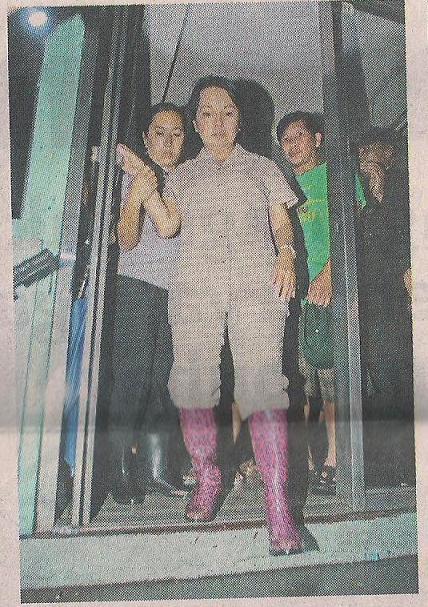
And so, here we are. The people we put in charge, the people to whom we entrust our monies and our fate. There is so much we do not know, so many questions to ask about the nitty-gritty of governing. For now let us ask this question, where did it go, our P5 billion supposedly spent on “flood control projects” last year?
The people we put in charge, bearer of public monies and public trust. Our state of affairs need not perennially begin in helplessness and end in tragedy. In 2010, when we choose people to put in charge, let us have faith in ourselves - that we deserve so much more than we have been given. And if we believe we so deserve a rational, functioning and clean government, then so must we exact.
Monday, June 22, 2009
Self and Society
Business World today has two excellent columns which, at first glance, do not seem to be interralted. The one written by Marivic Rufino pokes fun at snobbishness in our society. The other by economist Cayetano Paderanga is a melancholic account of how Filipinos have failed at economic development.
Reading the two in succession, I cannot help but see a correlation. While I am not one to privilege cultural explanations over the tremendous limits placed by unseen social forces, structural limits and the burden of history, I cannot but help reflect more and more towards our incomplete nation-building project. Above and beyond materially putting two and two to make four, our consciousness as a single cultural unit - bound and destined by fate towards a singular goal - is far from cohesive.
Rufino hints at a culture that does not lend itself to democratic principles - that is, at core, we are all equals. How does this fit with our on-paper republican ideals?
Paderanga notes:
But now, as the impatience and irascibility of age creep into my sentiments, I start to see that our failure has never been in the resources, the hard work, and the incremental adjustments that we have somehow missed. That somehow we have always found defeat in victory, that we would somehow undercut our own selves, that what we lack is something fundamental. Perhaps, it is the common vision, the common soul, the collective spirit that would make us work really, really hard and work as one with little attention to what is coming to us or our families; that special something that gives meaning to the self-sacrifice for the common good among us. I find this piece missing every time I witness the supreme egoism manifested in traffic snarls where nobody gives in to anybody, or when I see insensitive attention to the public in service areas, or when I witness the high-handed treatment of powerless individuals by powerful interests or officials. In fact, I see it everywhere; sometimes I see it in me. And I start to lose the optimism that my father gave to me.Is it an inability to see ourselves in each other that is today's social cancer? Far from the sense of community that underlined the Bayanihan spirit of our ancestors, have we devolved into this dog-eat-dog mentality where only the toughest, meaning those willing to do the dirty work, triumph?
Wednesday, April 01, 2009
Order, Politesse
We are experts at manipulating symbols, assuring humanity's dominance over the planet and all other species. Not only do we communicate with the visible formal code of language - letters, words, sentences, grammar - we manipulate and are manipulated by non-visible codes.
While words, and the meaning they carry, are by no means value-neutral, the agreement to or the dissent they pose to the existing order of things are explicit and easily corroborated or contested.
The kind of communication we should interrogate then, is that which largely goes unnoticed first because it is factual - i.e. matter of fact, and second because the message is delivered, not through language, but through the unconscious use of symbols.
Symbols are not only images but also objects and even ways of doing. Much as we produce that which constitutes our material life - food, clothes, houses - so too do we produce that which underpins and reproduces our ways of doing, our culture. Like it or not, we are unwitting participants in this process of cultural production. The trick then is to become conscious of the non-visible codes with which we communicate, especially so when they serve to cloak that which must be exposed.
In a society obsessed with appearances such as ours, behaviour, the outward manifestation of intent, not only mirrors the realm of production and how we fit in the system, but also serves to reinforce the current order and the extant hierarchies within. I find that appearances are especially important in a society empty of substance. Where form takes precedence over content, then you know appearances must be meticulously kept.
The labels ‘polite’ and ‘vulgar’ carry in themselves connotations of a positive and a negative way to behave. Certain behaviours are deemed acceptable and admirable while others deserve chastisement, even punishment. One must behave accordingly in certain situations. This signals who belongs to what socio-economic class and who doesn’t. What are ‘proper’ and ‘improper’ conversation topics? We use the term ‘class’ denoting someone of ‘good’ and proper taste. If we see society being divided into subgroups called classes, then why does having ‘class’ pertain only to those who belong in the elite bracket? Modes of behaviour and the production of culture of those who ‘have class’ solidify into norms and trickle down the social strata. Their culture, their ‘refined’ ways of doing things are then emulated by those who wish to be in their position vis-à-vis the rest of society. By emulating the form, the underclasses hope to aspire to substance.
In other ‘flat’ societies, those which have reached a measure of affluence and equality, ‘class’ ceased to mean anything. So too have notions of ‘distinction’ and ‘taste’ – markers and ways of doing which serve to emphasise difference.
Politeness is never more obvious between two persons of unequal power or socio-economic standing. ‘Vulgarity’ occurs when that which emphasises the power distance is transgressed. One communicates deference by verbal cues, ‘po’ and ‘opo’ being obvious markers. Other verbal cues include ‘ma’am’ and ‘sir.’ I have taken the habit of a journalist friend of mine, to address people in the tertiary sector – especially waiters and security guards as ‘boss’ in a tone of voice that confers deference to an expert, in the waiter’s case over his dominion in the kitchen and serving food, and the guard his dominion over giving directions or directing traffic on the parking lot.
Monday, March 30, 2009
Doomed to Leisure
The violence of mass consumption is a slow burn. It sticks to the skin and slowly eats away at the flesh. An array of objects and symbols subject the person in a battery of seduction. The senses are bombarded with loud, garish ploys designed to gain attention, engage in play and finally to seal the transaction. It picks away at your body, leaving none but bone.
Consider the conspicuous image of the girl, red-mouth puckered, sporting the shiny lip gloss. One is assaulted by her pixie eyes, her supple skin and that mouth ready to perform. The violence is in rendering in the victim a lack. That is, of pixie eyes and supple skin rendered perfect by the magic of image manipulators. A woman needs that lip gloss. A man needs that girl. Purchase to fulfil that mass of unarticulated desires.
Consider the image of a grinning heterosexual couple on a green field, flanked on either side by playing children and that dream house. So and so Realty is ready to gift you your dreams. All that you must want. All that you have worked for and have saved monies for is plastered on the giant wall. The anxieties of the norm slice through your fragile ego, articulating your lack, your deviance.
Consider the gadget framed in the vitrine. The shiny metallic glint signals to you the untold pleasures that can be had playing with it. You enter the store and play the simpering suitor, admiring it, caressing it as its pimp sings you its praises. It was created to cater especially to your needs, needful creature that you are. And you must have it to take home to play.
The phantasmagoria of consumption colonises all of the public domain, from one end of this metropolis to the other. Upon entering these churches both extravagant and small, one is forced to genuflect, to lay supplicant to the play of spectacle, to the blaring noise of sounds bouncing off shiny coated floors and walls. The faces of other worshippers are laid bare by harsh fluorescent lights. All are zombie-dead, sheep herded by things that facilitate movement from one space of consumption to the next. The MRT, the roadways, the escalators, the civilised spaces of this city - habitable, walkable, driveable – all lead to these places of worship.
Frankly, I am sick of all this.
-----
Read also The Depoliticisation of the Filipino and the Marketisation of Everything and In Response to Resty O.
Saturday, March 07, 2009
Fruits of Her Labor
The troops were assembling, a batallion of women from the communities. The heat of the afternoon sun was merciless, pricking the skin. There I sat next to a battle-weary colleague, a seasoned activist in his thirties. Cool in his shades he says, we should be organising for the nationalisation of the oil industry. Stung, I replied - this isn't as sexy, but just as important. No such thing as high politics or low politics, to my mind. The battle ground is culture - values, norms, standards. The scale is the micro and gendered politics of the home. At stake are bodies of women and what can and cannot be done with their reproductive functions. What a jaded, unfortunate thing to say, I thought, for someone who'd been at this far longer than I have.
Our purple bandanas were a meagre protection from the sun, but I put one on my head anyway. A lady in a brightly-coloured top was distributing them to rows of six to five. Another colleague looks through the lenses of his camera, documenting the preparations for the short march to the House. Through the scope he scanned the ladies hoisting their brightly-coloured placards. The booming voice of a community leader could be heard among the ranks, practising the chant of the march. I thought, nobody would hear the chanting, but it was probably more for the marchers than for anyone else, to keep energy from flagging.
As with many aspects of this country, the politics of gender is as multi-faceted and conflicted as our democratic process, our national project, our class formations and alliances, our cuisine. A developing country which regularly ranks high in alleviating gender inequality, it nevertheless thrives from the perpetuation of traditional roles of women. Many Filipinas leave their homes only to perform similar domestic roles elsewhere. The only difference is, for mothering young children or caring for the sick and elderly of others, they gain a handsome remuneration. The migrant Filipina’s remittances purchase the labour of other women to take care of those she left behind.
Women’s labour earn most of this country’s foreign exchange, as migrants and as workers in the electronics industry. Women constitute 74 percent of electronics industry workers, amassing more than $27 billion a year in exports for the Philippines. Semiconductors account for over 70 percent of Philippine exports (McKay 2006). In the wet dreams of the foreign investor, the docile Filipina would never think to organise a union as the rent-seeking local government would never think to enforce labour standards. There she sits, quietly assembling the micro parts of the chip, her nimble little fingers and eye for detail put to good use.
The President is a woman, the matriarch of the Philippine household. Reflective of our quasi-feudal society, the fruits of her labour accrue to her husband, her children and their myriad hangers-on. Meanwhile the government she has inherited perpetuates the export of women’s labour of care – nannies, care-givers, nurses, entertainers, teachers, sex workers. She wants to export more than a million this year. Typical of many of this country’s contradictions, a woman wearing the pants in her home leeches blood from the domesticity of other women.
The two o’clock sun reflects heat from the cement road on the way to Batasan. Cars honk their horns in derision or solidarity, I don’t know. Reproductive health always elicits snickers. Apparently it isn’t serious business when a woman has no choice what happens to her own body. But then, a woman constantly pregnant and home-bound is the ultimate expression of Filipino domesticity.
------
McKay S. (2006). "Hard Drives and Glass Ceilings: Gender and Stratification in High-Tech Production." Gender & Society 20(2), pp 207-35
Thursday, March 05, 2009
Womanhood, Othering
It may be doing development work for women, it may be because I no longer see exclusively from the privileged position of a bourgeois female, it may also be because I have experienced being in the position of ‘Other’ that I am sensitive to every perceived slight to my womanhood. Having grown up with a strong figure of a mother – who spoke her mind as she wanted and cared little for what others thought – I only realized later on that my model of femininity isn’t the norm. I also realized very late in life that I am afforded many advantages, even as a woman, because of my privileged position in this societal context.
It is only when you travel overseas, stripped of the context in which others perceive you, that you fully realize what it means to be the ‘Other.’ In postcolonial literature, the colonial ‘Other’ is not and cannot be the metropolitan ‘Self.’ Colonial relationships are unidirectional with one determining and imposing standards on the other. In our (still) complicated relationship with the United States for example, one is developed and one is not. One is mature, the other immature. The Other articulates a lack of what the Self possesses – wealth, democracy , freedom. In this unidirectional relationship lies hierarchies of power.
The same principle can be applied to the relationship of men and women. Othering has been easily adapted in feminist literature for obvious reasons. In biblical imaging for example, a woman is nothing but an appendage – a complement and helpmate to the fully-formed man. She can never self-articulate independently. Her being, her identity is forever pegged to the standard set by the male Self. If she wants to attain the same level of ‘Selfhood’ the male possesses, she must strive to be as masculine as possible. Her being woman can never be the standard.
I was 20 when I was harassed by an old man, probably in his 50s, in a park in Madrid. In the Philippines, my demeanor, the way I speak, my very appearance may have accorded me some protection against such an act. But as it was, I was young, female and not white in a park chatting with my equally young, female friend. Having only rudimentary knowledge of Spanish, I sat uncomprehending as the old man spoke rapidly while he swayed unsteadily on his feet. There was no mistaking the tone of his voice. I responded in English, telling him I could not understand what he was saying. As he ranted for a few minutes more, I was comforted by the fact that it was still light, and there were other people still in the park.
Probably incensed at my incomprehension and my blank face, the old drunkard finally gave up and walked away. I looked to my friend who spoke Spanish. Without hesitation she told me he just wanted to know my name and where I lived. As I looked blankly at him, or probably because I didn’t behave in the welcoming way he expected, he remarked that I was stand-offish and that he knew I was a Filipina servidora, and didn’t I want to marry a Spaniard?
I may have been too young to fully process what had happened. What was novel was the feeling of inadequacy – that there was something wrong with me for being female, for being young, for being Filipina, and for being a servidora. In that particular context, all four identities took an equivalence. The underlying connotation, communicated by his tone, was something akin to being contemptible and unsavory.
In the Philippines, we come to expect to be treated with decorum by the underclasses. In a highly hierarchical society such as ours, a person of perceived low standing – a waiter, a janitor, a maid - would behave a certain way to remind us both of each other’s position. We may be so gracious and polite as to treat the Other with respect and courtesy – but get offended when he behaves in an ‘uppity’ manner. We are offended when the Other acts out of place and so we react to reinforce the hierarchy between.
Having lived for sixteen months in a different societal context, I was stripped of layers of my identity which accorded me a privileged position - my (over)education, my not belonging to the Filipino underclass, my skin color. In Australia I was an Other. Young, female and Asian. In the white man’s imaginary, an Asian woman behaves a certain way. And in Australia, if you’re Filipina and look Chinese or Thai at the same time, you may well be someone’s mail-order bride and all that implies.
I had drastically gone down the ladder of positional power. It is a refreshing, novel perspective. For the first time I knew what it felt to be invisible, in a certain professor’s class, among certain peers, in the supermarket. Australian idealism values equality, multiculturalism and giving people a fair chance. These are ideals, however, and do not always apply.
Perhaps the most enlightening has been discovering aspects of my femininity that were previously matter-of-fact and unproblematic. Having met males from all over the world during my studies, I was constantly reminded, in small, inconspicuous ways, of how I was not behaving as I should. Progressive males will re- assess, and you literally feel a change in their behavior. Regressive males will then proceed to patronize or ignore you altogether. Being patronized was a novelty I would not soon forget.
A Filipino male is usually protective and careful of a crying woman. I had never before been made to feel like a simpering weakling as I showed emotion in the class of a (bigoted) Scotsman. I was female and was reacting irrationally to images of violence in the Middle East. Growing up, tears had always been a sign of empathy and a way to communicate distress. For the first time, and what a novelty it was, tears were a sign of inadequacy to the unemotional, rational male.
Perhaps the most difficult lesson I had to learn, having been in a relationship with a young man who probably got into a relationship with me to fight off his latent misogyny (among other things) and because he said he wanted to be with a woman of substance for a change, is to assert my womanhood without crushing the male ego. Oh and what a fragile thing it is.
Friday, January 02, 2009
Resentment and Cultural Oppression
The French word ressentiment which translates to the English word "resentment" literally means to "feel again." Doomed to repetition, resentment towards this society's emptied culture and cyclical politics can be at times overwhelming. Many have found the solution to this often crippling frustration. To relieve oneself of ressentiment one must deaden feeling.
And so here we breathe, creatures of routine, carving superficial predictabilty and stability to live our lives. But is it truly living? To endure so much for the sake of superficial order is slow suicide. Doth we protest much?
To tamp down expectations, indeed to have no expectations at all from what is external is supposedly pragmatic. So here we retreat to the sanctity of the private spaces we occupy - our homes, our work, our leisure. Our heads buried in sand, we inhale. The world will somehow right itself without us doing, like magic.
Hypocrites or fools? Are we so comatose as to have abandoned all conceptions of the ideal? Subservient slaves we are, comfortably rolling in the filth in which we live. As everyone is now equally dirty, we seek not what is clean. No expectations of triumph, good will or trust in each other's capacity for public good. No sense of what is just and moral without faith in god - who will magically, without our doing, make things right.
Why bother, some say. Why indeed? In this day and age this easily remedied by trading one form of slavery for another. The magic of transporting oneself to another locality has its advantages - better wages, better living. The sacrifices may be more than incalculable for some, but no matter. No better life can be imagined in this locality, and so it must be sought elsewhere. And yet we return. We return out of duty, guilt or gloating.
So our barren imaginations cannot conceive of a better way of life, aside from inane platitudes of those who would seek greatness where there is none.
I resent that there is not more. I resent that we cannot imagine more. I resent that we dare not more. I resent.
Sunday, December 14, 2008
The Depoliticisation of the Filipino and Marketisation of Everything
It begins with the Self - the subject at first born free then subsequently shaped and subsumed by its environment. The political is born of the bargaining of conflicting desires of individual selves. The political dies in the event where all desires are harmonised. Anti-politics it is called. While conflicts remain in the realm of the real - manifesting in actual wars, in petty crimes, in the overburdened justice system - they take a backseat to the realm of the unreal, that seething mass of collectivised desires, fed by the basest insecurities of our ego.
The siren call of self-realisation is impossible to resist. The call is heeded in those gigantic structures that litter the urban landscape. In these sanctuaries of hyperconsumption we engage in highly ritualized masturbation. The Self abuses the commodified body - that blank canvass to adorn, to modify, to pamper. To satisfy the self-perpetuating hunger for ego-stroking, the Self must sell its labour to the market, earn enough to reproduce itself its life and its lifestyle, then quickly return to the leisurely activities with which to prop its ego.
Individualised selves comprise this atomised urban society. They are in general young, hip and cosmopolitan. Now a good majority are plugged in to the globalised economy, their body clocks ticking in disharmony from the local, their id swimming in deterritorialised tastes and norms. For this class of selves, the facade of the public are inconvenient barriers that must be transcended, for collectivised desires always reside in the realm of individual private consumption. The public sphere is an anomaly, a paean to a collective identity, an anathema to the autonomous Self.
This, however, does not preclude social relations between Selves. However these relations can only be mediated by market relations. Friendships, loves, kinship are entangled in the web of monetisation. Social relations are at base motivated by the need to quench the thirst of the fragile ego, which can only be satisfied by the currency of money, that symbol of power and capacity in this late stage of modernity.
In the peripheries and interstices of urban centres, there reside masses of bodies unrecognsible. Undifferentiated, inconsequential, eking sustenance from the dregs of the urban centres' wealth-creating machine. These non-Selves are unable to self-articulate and are thus rendered mute. Like garbage and stray animals on the streets or politicians on television, they are background decoration of the public. To avoid seeing the often ugly morass of these bodies and the facade of public institutions - the articulated Self rarely ever ventures in the public sphere. It prefers to inhabit the private sanctuary of its labour and its leisure. It prefers to extenuate social relations with other Selves similarly bent on satisfying collectivised desires of consuming mass-produced objects and mass produced culture, to realise its increasingly mass-produced Self.
Friday, November 14, 2008
Small p, big P
Of the people we know, how many take interest in politics? In this country, it is synonymous to greed, filth, corruption. Politics is never associated with honor, justice, ideals.
The spectacle of Bolante's interrogation in the Senate is a perfect example of how we tend to focus on the small p, not the big P. I'm afraid traditional media has a role in this kind of discourse. Through its filter of information, we are fed "frames" on how to interpret events. They've got the who, what, where, when and how covered. "Why" is probably the most difficult, and so there is little media coverage following this line of questioning.
The small p will focus our attention on the details of the fertilizer scam. People whom I've heard discuss the media spectacle do so in jest, as though it were entertainment. In a way it is. That is the frame we are fed.
A discourse on the big P will frame this spectacle within a larger context - the crisis of our agricultural sector, the corruption diverting funds away from farmer support, the food security of the country, the global crisis in agriculture given the current international trade system.
Let's focus on the big P. The bigger, the better. :)
Thursday, October 09, 2008
On Prostitution
Corollary to the BBC brouhaha, Jeg writes a post on the world's oldest "profession":
A prostitute's body is a fictitious commodity. It is is not "produced" for consumption in the market. Like bags and tupperware. When her body is consumed - like agriculture, her value is "renewable." Her body as commodity does not disappear. However it "depreciates" because her customers put value in pliable, wrinkle-free flesh. Is her body a public good then? Like clean air and public order? A private good by definition must only be consumed by one.
And what about the value of her service? Why do societies around the world normally equate prostitution with women? Do women not require sexual release without strings attached as men? There is a stastic somewhere that in the US at least as many as 60 percent of men who hire prostitutes do not engage in intercourse. They talk. He confides in her. She listens. In this case, what kind of service is she offering? Care? Attention?
We go back to the issue of motivation - is it her own free will to engage in prostitution? Can anyone think of any other work where a human being sells both his service (i.e. labour) and the use of his body in a transaction? Hm...acrobats maybe?
Not one to pass on the chance to defend scantily-clad women, I asked why is it sexploitation. Those dancers were not being coerced. They freely chose their profession and are being paid for it. And with that I think it is time to come to the defense of what is called the World's Oldest Profession, the prostitutes, those purveyors of venereal services that society has maligned; indeed our legal system considers their profession illegal. A prostitute is here defined as one who engages in sexual services for a fee.A slippery slope we have here. I can only think of more questions in response to this post. Does anyone willingly choose to become a prostitute? As a worker who engages in the labour market, what does a prostitute offer? Sex as a service? Her body as a commodity for consumption? Both? Can we compare services rendered by, say, a call centre agent to that of a prostitute? A call centre agent sells his time, his expertise, his skills as service. This does not include his body for exploitation (i.e. use) and consumption.
A prostitute's body is a fictitious commodity. It is is not "produced" for consumption in the market. Like bags and tupperware. When her body is consumed - like agriculture, her value is "renewable." Her body as commodity does not disappear. However it "depreciates" because her customers put value in pliable, wrinkle-free flesh. Is her body a public good then? Like clean air and public order? A private good by definition must only be consumed by one.
And what about the value of her service? Why do societies around the world normally equate prostitution with women? Do women not require sexual release without strings attached as men? There is a stastic somewhere that in the US at least as many as 60 percent of men who hire prostitutes do not engage in intercourse. They talk. He confides in her. She listens. In this case, what kind of service is she offering? Care? Attention?
We go back to the issue of motivation - is it her own free will to engage in prostitution? Can anyone think of any other work where a human being sells both his service (i.e. labour) and the use of his body in a transaction? Hm...acrobats maybe?
Cross-posted at Filipinovoices.
Wednesday, September 17, 2008
Popcorn Na Lang
This is just a small preview of the exciting events happening in the HOR now that the RH bill ha finally reached the floor for debate. Kung pwede lang magbaon ng popcorn sa loob ng session hall. Hehehe.
(Re)producing the Democratic Process
If I were of a less moderate temperament, I would have long used by Pilot G-tech C4 to stab the CBCP's lackeys in Congress.
Last night was testament to the dirty tactics employed by the likes of Rep. Pablo Garcia, Rep. Apostol and the queen of bungangeras Rep. Susano. They're obviously in panic mode now that the RH bill, in its umpteenth incarnation, has reached the farthest ever stage in Philippine legislation. In the Committee on Rules hearing last week Rep. Delmar, Rep. Velarde, Rep. Golez and Rep. Rodriguez (and their silent partners) all tag-teamed to stop the bill from being debated on the floor for all congressfolk to hear both those for and against the bill. They wanted to stop the discussion at committee level. Rep Delmar, in an impassioned but woefully misguided and exaggerated diatribe, said this bill is "divisive" and will potentially cause a "political crisis" never before seen in the country. Blah blah blah.
In an appeal to emotion, Rep. Golez said the bill was just about babies. 27 babies born in each barangay. That is the problem, he only sees the issue at hand from such a narrow perspective. This issue is more than just about sex and reproductive health. Its about reproductive justice, gender relations, women/mother empowerment, quality life, socio-cultural change, human capital investment and economic growth and development.
Last night the opposition would not even allow one person to deliver a sponsorship speech. The debates will not even take place 'til next week!
To be continued...
-------
Read HB 5043 here.
Sign the petition in support of the bill here.
Wednesday, September 03, 2008
Sex and Politics: An Appeal to Reason
Why is there a need for a comprehensive legislation on population and reproductive health?
The Philippines’ policy on population and reproductive health (including family planning) has always been dependent on the incumbent. The late President Ferdinand Marcos instituted various commendable policies on said issues. However, President Corazon Aquino’s ambiguous stand on the role of family planning adversely affected the implementation of the national family planning program by the Commission on Population (POPCOM) and its partners.
Former President Fidel V. Ramos’ administration, in contrast, saw a strong support for family planning initiatives as it was sought in the context of sustainable development. When Joseph Estrada became President, enlightened officials in his Cabinet aggressively pursued and implemented family planning programs albeit the lack of any official pronouncement on population and family planning.
Estrada was replaced by President Gloria Macapagal-Arroyo, whose stand on the matter of population has been flip-flopping. She once acknowledged the need to reduce the country’s population growth rate to 1.9 percent, only to say in another statement that she is leaving the matter to local government units.
Relegating the responsibility of crafting and implementing policy interventions on population, reproductive health at the local level is not a viable option. This would lead to unsustainable and uneven programs across LGUs because of the relatively short term of LGU officials (3 years), disparities in internal revenue allotment (IRA), and the local official’s priorities, among others.
A number of progressive local government units like Aurora, Ifugao, Marikina, and Davao City have already put in place family planning and reproductive health policies and programs in their respective areas. But what to do with a city as big as Manila, where any form of information and services related to family planning has been banned?
Unless a comprehensive national legislation on population and reproductive health is put in place, our people’s right to complete, accurate and comprehensible information, and comprehensive services on population and reproductive health will always be dependent on the whim of the powers that be.
What is wrong with the government’s recent natural family planning-only (NFP-only) policy?
Universal access to a constellation of methods in family planning utilizing a principle of voluntary choice is founded on the 1987 Philippine Constitution, which guarantees for every human person full respect for human rights (Sec. 11, Art. 2,). Moreover, the fundamental law of the land gives due cognizance to the particular needs of women for gender equality (Sec. 14, Art. 2); of the youth to enjoy protection of their physical, moral, spiritual, intellectual, and social well-being (Sec. 13, Art. 2); and of spouses to found a family in accordance with their religious convictions and the demands of responsible parenthood (Sec. 3:1, Art. 15).
A policy focusing on natural family planning alone actually goes against these Constitutional principles. The government’s Natural Family Planning-only (NFP-only) policy will isolate the majority of women who prefer modern and artificial methods. Focusing only on natural methods is disempowering and discriminatory to women as it deprives them of universal access to the whole range of family planning methods so that they can choose what is most appropriate for their bodies, in accordance with their beliefs.
International and local studies have established that natural methods are not for everyone. For example, the standard days method is effective only for women whose menstrual cycles fall between 26-32 days and requires the unfailing cooperation by the husband as the couple must abstain from sex for 12 consecutive days during the woman’s fertile period.
Various national surveys of the National Statistics Office have also revealed that Filipinos prefer modern family planning methods, with pills as the consistent no. 1 method of choice.
The government’s NFP-only policy will also reverse the gains in lowering fertility and slowing down population growth to propel national development. It is impossible to achieve the government’s 1.9 percent population growth rate target if other legally permissible and medically-safe family planning methods are disregarded.
If government is really concerned about women’s fear of side effects and complications, and the general acceptability of modern methods, then, it should put its resources to programs for educating people on the pros and cons of all methods, rather than a policy imposing only one method.
What hampers the establishment of a comprehensive legislated policy on population and reproductive health?
Some leaders of the Catholic hierarchy and lay organizations have vigorously opposed reproductive health, family planning and population initiatives. While these groups have the right to stand for their religious beliefs, as guaranteed by the Constitution, the situation becomes problematic when they threaten and coerce those who believe otherwise, as what has been happening come election time. During the 2004 elections and in the 2007 elections, members of the Catholic hierarchy and lay organizations have been known to campaign against candidates supportive of policies and programs on population, reproductive health, and family planning. This is highly inappropriate as these candidates, when elected into office, will have the responsibility of crafting policies and implementing programs that will benefit all Filipinos, whether Catholic or otherwise. Moreover, data from the 2003 NDHS show that only 2.4 percent of married women cite religion as their reason for not using contraception.
Sadly, there are also leaders in government who choose not to recognize that the country’s population and reproductive health situation really needs to be addressed as it has serious negative impacts on our development as a nation. By turning a blind eye on the situation, they are failing to concretely address the people’s needs.
Do the people want reproductive health and population policies and programs?
The results of the Pulse Asia Ulat ng Bayan surveys on Family Planning done in 2000, 2004 and 2007 indicate the people’s consistent clamor for a comprehensive national policy on reproductive health and family planning.
In particular, the March 2007 Ulat ng Bayan findings reveal the following:
- Nine out of 10 Filipinos (92%) consider family planning important.
- Nearly 8 out of 10 Filipinos (76%) believe in the importance of including family planning in a candidate’s program of action.
- Three-quarters of the adult Filipino population (75%) will support candidates who are in favor of a government budget for family planning.
- About 9 in 10 Filipinos (89%) think it is important that government provide budgetary support for modern methods of family planning including the pill, intra-uterine devices (IUD), condoms, ligation and vasectomy.
- One in two Filipinos (50%) is of the opinion that rapid population growth hinders the country’s development
- A larger proportion of Filipinos believe that the church (or religion) should not participate in the issue of what family planning methods couples should use (44% vs 33%).
Wednesday, August 06, 2008
Michel Lagravère Peniche: French-Mexican Killer
This 10-year old killer of bulls has been allowed to show his craft in France.
I don't know if killing bulls is something to brag about, as 'Michelito's father is wont to do: "No one ever stopped Mozart playing the piano or Maradona kicking a football -– so they should just leave him alone."
Err, yeah, my son's special talent is killing male cows while wearing über tight pink pants. Great.
Wednesday, July 30, 2008
Zeitgeist
If we don't start shifting our focus on CARP reform soon (where the Church is an ally) I might finally turn from a tolerant agnostic to a raging atheist!
And now I come across the film 'Zeitgeist' floating on the internet. The first part is a fascinating account of how the Christian religion drew much inspiration from astronomy, astroogy and the study of the natural world. Because 'religion' for some reason (err, lack of reason?) develops an unquestionable infallibility because, well, it is religion, we never hear of accounts such as this one. If we offer a class on the history of Christianity, either we gain a deeper appreciation and understanding of faith or we all convert to something else. I'm betting on the latter.
This FASCINATING stuff. Not for the faint of heart.
Thursday, July 17, 2008
Kritika Kultura Lectures
Department of English
Ateneo de Manila University
School of Humanities
“QUIAPO MON AMOUR”: THE GLOBAL MAPPING OF A STREET CINEMATHEQUE
by
Jasmine Nadua Trice
18 July 2008, Friday
4:30 – 6:00 p.m.
Faura Audio-Visual Room
About the lecture:
This lecture provides an overview of my dissertation project, tentatively entitled Imagined Communities, Imagined Cosmopolitanisms: Spaces of Cinema Circulation in Manila, Philippines, 2006-2008. Grounded in cinema studies, the work examines the circulation of independent cinema in Manila, Philippines, focusing on "alternative" sites of exhibition and their positions within the overlapping arenas of art and politics. Combining participant-observation with analysis of cinema texts and their surrounding discourses in media and institutional documents, the project argues that examining the processes of these works' production, distribution, and exhibition within a specific, urban setting offers new frames for studying local cinematic cultures in the contexts of globalization, frameworks usually approached through audience reception ("resistant" readings of global mass culture) or production (textual analysis of radical works). Rather, by viewing the circulation of small scale works whose experimental aesthetics or radical politics place them at a distance from the more commonly examined global mass culture, the project aims to develop a new approach to cultural goods' local and transnational flows. It examines the ways this model operates within a distinctive system of cultural capital driven by aesthetics, politics and the cachet of internationalism, but ultimately, committed to local artistic communities and political solidarities.
About the speaker:
Jasmine Nadua Trice, a PhD candidate of the Department of Communication and Culture/American Studies Program of Indiana University, takes research interest on cinema theory, history and production, globality, cinema exhibition, new media, reception and audience studies, national cinema, experimental cinema, third cinema, post-coloniality, media spaces, ethnography, gender, and the everyday. She was also an associate instructor in the Department of Communication and Culture, Indiana University.
-----------------
Kritika Kultura Lecture Series
invites you to a lecture
Time Passante: From Forensic to Interrogation Modernity
by
David Lloyd
Professor of English, University of Southern California
22 July 2008, Tuesday
1:30 – 3:00 p.m.
Faculty Lounge, De la Costa G/F
Ateneo de Manila University
About the lecture:
The lecture will discuss Walter Benjamin on Baudelaire, Bobby Sands's prison ballads and contemporary techniques of in-depth interrogation. It will draws on the experience of Irish political prisoners to explore the way in which interrogation has become a generalized mode of subjectification in late modernity (as opposed to the forensic mode of earlier periods).
About the speaker:
David Lloyd, Professor of English at the University of Southern California , is the author of Nationalism and Minor Literature (1987); Anomalous States (1993); Ireland After History (2000) and Irish Times: Essays on the History and Temporality of Irish Modernity (forthcoming 2008). He is currently at work on two further books, A History of the Irish Orifice: the Irish Body and Modernity and a study of Samuel Beckett’s visual aesthetics. He has co-published several other books: Culture and the State, co-authored with Paul Thomas (1997), The Politics of Culture in the Shadow of Capital (1997), with Lisa Lowe, and The Nature and Context of Minority Discourse (1991), with Abdul JanMohamed. A poet and playwright, he is in the International Board of Editors of Kritika Kultura. His major publications easily mark Prof. Lloyd as an important intellectual in literary and cultural studies today.
Ateneo de Manila University
School of Humanities
“QUIAPO MON AMOUR”: THE GLOBAL MAPPING OF A STREET CINEMATHEQUE
by
Jasmine Nadua Trice
18 July 2008, Friday
4:30 – 6:00 p.m.
Faura Audio-Visual Room
About the lecture:
This lecture provides an overview of my dissertation project, tentatively entitled Imagined Communities, Imagined Cosmopolitanisms: Spaces of Cinema Circulation in Manila, Philippines, 2006-2008. Grounded in cinema studies, the work examines the circulation of independent cinema in Manila, Philippines, focusing on "alternative" sites of exhibition and their positions within the overlapping arenas of art and politics. Combining participant-observation with analysis of cinema texts and their surrounding discourses in media and institutional documents, the project argues that examining the processes of these works' production, distribution, and exhibition within a specific, urban setting offers new frames for studying local cinematic cultures in the contexts of globalization, frameworks usually approached through audience reception ("resistant" readings of global mass culture) or production (textual analysis of radical works). Rather, by viewing the circulation of small scale works whose experimental aesthetics or radical politics place them at a distance from the more commonly examined global mass culture, the project aims to develop a new approach to cultural goods' local and transnational flows. It examines the ways this model operates within a distinctive system of cultural capital driven by aesthetics, politics and the cachet of internationalism, but ultimately, committed to local artistic communities and political solidarities.
About the speaker:
Jasmine Nadua Trice, a PhD candidate of the Department of Communication and Culture/American Studies Program of Indiana University, takes research interest on cinema theory, history and production, globality, cinema exhibition, new media, reception and audience studies, national cinema, experimental cinema, third cinema, post-coloniality, media spaces, ethnography, gender, and the everyday. She was also an associate instructor in the Department of Communication and Culture, Indiana University.
-----------------
Kritika Kultura Lecture Series
invites you to a lecture
Time Passante: From Forensic to Interrogation Modernity
by
David Lloyd
Professor of English, University of Southern California
22 July 2008, Tuesday
1:30 – 3:00 p.m.
Faculty Lounge, De la Costa G/F
Ateneo de Manila University
About the lecture:
The lecture will discuss Walter Benjamin on Baudelaire, Bobby Sands's prison ballads and contemporary techniques of in-depth interrogation. It will draws on the experience of Irish political prisoners to explore the way in which interrogation has become a generalized mode of subjectification in late modernity (as opposed to the forensic mode of earlier periods).
About the speaker:
David Lloyd, Professor of English at the University of Southern California , is the author of Nationalism and Minor Literature (1987); Anomalous States (1993); Ireland After History (2000) and Irish Times: Essays on the History and Temporality of Irish Modernity (forthcoming 2008). He is currently at work on two further books, A History of the Irish Orifice: the Irish Body and Modernity and a study of Samuel Beckett’s visual aesthetics. He has co-published several other books: Culture and the State, co-authored with Paul Thomas (1997), The Politics of Culture in the Shadow of Capital (1997), with Lisa Lowe, and The Nature and Context of Minority Discourse (1991), with Abdul JanMohamed. A poet and playwright, he is in the International Board of Editors of Kritika Kultura. His major publications easily mark Prof. Lloyd as an important intellectual in literary and cultural studies today.
Subscribe to:
Posts (Atom)