Showing posts with label Democracy. Show all posts

Monday, November 22, 2010

A Year Ago: The Ampatuans

Human Rights Watch recently published a report on the Ampatuan Massacre last year:
This 96-page report charts the Ampatuans’ rise to power, including their use of violence to expand their control and eliminate threats to the family’s rule. It is based on more than 80 interviews, including with people having insider knowledge of the Ampatuan family security structure, victims of abuses and their family members, and witnesses to crimes.

See the full report here.

Sunday, July 04, 2010

Unpacking the Church

In "Chastising Democracy: Does the 'Conservative Turn' among Filipino Catholic Bishops Mean a Retreat from (Democratic) Politics?" Prof. Raneses argues the Church, despite itself, may help deepen democracy in the Philippines. The liberal and leftist critiques of the church as an actor dismiss its role in pluralizing voices.

The article also provides a review of literature on the Philippines and theories of democratization.

Interesting.

Chastising Democracy: Does the “Conservative Turn” among Filipino Catholic Bishops Mean a Retreat from (Dem...

Thursday, July 01, 2010

(Blogwatch) It Augurs Well

We’re inclined to believe the worst in our leaders. It is the automatic option. Faced with a choice between blind faith and skepticism, we are apostates. Is it borne of our revolutionary tradition, this distrust of authority? Or more a fruit of our useless labors throughout the years? How does one cope with perpetual disappointment? A refusal to believe in the possibility of anything.

Read the rest at the Philippine Online Chronicles.

Monday, May 31, 2010

(Blogwatch) Freedom of Information: Antidote to Tyranny

Tyranny may change in form, adapting to the milieu in which it must be deployed and exercised, but it never changes in principle. In the olden days, a naked display of power – an army of mercenaries or soldiers – is enough to subdue an uncooperative populace. The tyrant commands through the monopoly of instruments that physically coerce - instruments of hurt, instruments of pain. The constant principle is that the tyrant gets what she wants, no matter the opinion of those whom she rules. This is the very antithesis of democracy.

Read the rest here.

Wednesday, March 24, 2010

The Spirit of the Law and the Ghouls of Arroyo

There are two ways of looking at a country’s legal system. One is that it embodies a set of rules that regulate actions of those bound by the law – legal personalities who inhabit the country in question. It is ‘unlawful’ or ‘illegal’ to steal from your neighbor. The capacity to say that it is wrong to commit such an act shapes the behavior of those who commit themselves, as citizens, to the legal community (i.e. country). To add teeth to the law, there are also all sorts of punishments levied upon those who transgress what is lawful or legal. You pay a fine, you do community service, your liberty is taken away. Seen this way, laws are a set of rules designed to regulate or harmonize a community. They assure order and a measure of peace so that citizens might go about their daily lives with as little hassle as possible.

But what makes stealing unlawful? Or killing? Or rape? These are not ‘unlawful’ just because. The rules by which we abide are moral judgments. It is morally wrong to steal, kill and rape. Why? Because those who have drafted these laws and the community which protects and/or abide by them have put value on one being able to keep one’s possessions and one not being killed or raped by any random person. These values, in turn, are also underlined by a chain of other values – the sanctity of private property, the sanctity of life, the sanctity of dignity. And so on.

Wednesday, February 24, 2010

The Politics of Owning and Remembering EDSA

A monopoly on history is a monopoly of power. A monopoly of telling the narrative can only match the writer's ideological standpoint. What really happened in EDSA? Who were the protagonists? The bad guys? Those who chose to sit on the sidelines? What was the context in which the event happened? Was it planned or spontaneous? What were the events that led to it?

If remembering is a way to reconstruct events in history, then different sections of society will see the past through multiple views. The view from the left is not the same from the right. The view from the top cannot be the same as that from the bottom. What is not contested is that the People Power revolution was good. This is probably why so many camps seek to co-opt EDSA to suit their own purposes today. Co-opting EDSA endows one with magic/legitimising properties. Co-opting EDSA allows one to be morally right. And so it seems, rarely do we 'remember' in an entirely objective manner. On such a momentous event as the People Power revolution, the politics of remembering is rife.

Perhaps the tendency to multiple views on EDSA 1986 is a measure of how fractured and segmented we remain. In a sense, what was true twenty-four years ago remains true today. Those who would insist that no such fractures exist are ideologically blind if not idiots.

Sunday, January 03, 2010

Off the Endangered List: Philippine Democratization in Comparative Perspective

This assessment was written in 1996. Author Mark Thompson offers one key element that could make or break the Philippine democratisation project. Thirteen years later, it seems we failed to meet this element. And so, here we stand.
"A key to stable democracy is the extent to which weak performance, particularly in the economy, leads to system blame. Recent democratic transitions in Portugal and Spain occurred under poor economic conditions, but the people of neither country attributed them to democracy. In the Philippines, the record of democratic commitment is mixed. Since the fall of Marcos, the high opinion ratings given democratic politicians despite declining living standards speaks for stability. Although at the midpoint of the Ramos presidency the Philippine economy is improving (with a growth rate of 5.1 percent in 1994, projected at 6.5 percent in 1995), it has a long way to go to match the "miracle" economies of most of its Southeast Asian neighbors. In the pre-martial-law Philippines, government corruption and economic problems contributed to growing elite criticism of democracy. Political leadership has made the decisive difference between then and now: Aquino's (and thus far Ramos's) commitment to democracy contrasts with Marcos's destruction of it. However, if the Philippines does not achieve sustained development, the temptation to exploit this failure could again endanger the country's democracy."


Off the Endangered List: Off the Endangered List: Philippine Democratization in Comparative Perspective -

Monday, September 28, 2009

People in Charge: A Letter to the Filipino

It is perhaps part of our culture to have blind faith in many things, not least faith in two social forces that most shape our collective lives – god and government. This weekend has clearly demonstrated that our faith can only take us so far. God only helps those who help themselves. And government will only help itself unless pressured to do otherwise. We should perhaps take stock of what burden, what “charge,” we should place where appropriate. We cannot have blind faith that god will provide and succor. We cannot have blind faith that government will govern.

Of force majeure Ondoy, we have no control over. But we need not remain resigned to the caprice of nature and fate. Civilization tells the story of man’s battle to tame nature. All of science is a monument to this undertaking. For each difficulty posed by nature’s tyranny, humankind has dreamed of and fashioned solutions. Why can’t we? Typhoons, harbingers of disaster, come and go like the tide. Yet all these years, all these decades, we succumb blindly to fate. Fatalism is a condition that belongs to olden days. If there is progress, then there is no room for blind acceptance of what becomes of us.

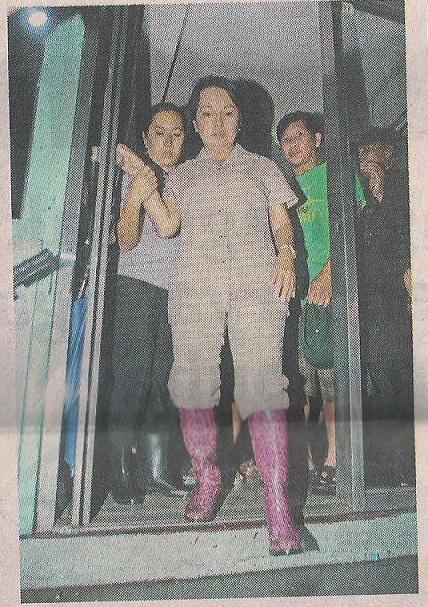
And government – oh government. As we see names and personalities play their roles before us on our TV screens, we ask ourselves where the make-believe ends and where reality begins. The President wades in water in her pink boots while her son searches and rescues booze in a liquor store. Our leaders, ourselves? I despair. Yet perhaps this statement is unfair. Government or no, we have seen stories of people who help themselves. There is heroism in grand scale committed by humble nobodies. There are unknown soldiers who have gone beyond the call of duty. There is that 18 year-old construction worker who has saved thirty lives only to lose his. There is that father who mourns the computer for which he scrimped and saved to gift his son. His house and all he owns buried in mud, he endeavors to go on.

And so, here we are. The people we put in charge, the people to whom we entrust our monies and our fate. There is so much we do not know, so many questions to ask about the nitty-gritty of governing. For now let us ask this question, where did it go, our P5 billion supposedly spent on “flood control projects” last year?

The people we put in charge, bearer of public monies and public trust. Our state of affairs need not perennially begin in helplessness and end in tragedy. In 2010, when we choose people to put in charge, let us have faith in ourselves - that we deserve so much more than we have been given. And if we believe we so deserve a rational, functioning and clean government, then so must we exact.

Monday, August 03, 2009

That Infallible Heart

I have searched for words to describe my reaction upon learning of Cory Aquino’s death. Days before, knowing she was terribly sick, I did not feel anything. Not grief nor sadness but a sense of inevitability. Nothing is finite and all beginnings must have an end. Since I do not have a god to which to pray, I had no recourse to the usual avenues of comfort.

On Saturday morning a friend alerted me to the news before I could plug in. The whole weekend I searched for a way to articulate my feelings and the thoughts in my head. I watched a few of her speeches on YouTube and sat teary-eyed every so often. I remembered what I had said earlier when the false news of her death had leaked, I’d said “Her death will mark a sunset to many things.”

Cory was our neighbor, my playmates said. She lived a few dozen meters down from my home in Kalookan. My playmates and I would come to her house and steal glimpses of her from outside her gates as she moved about her home preparing meals or scolding her children. We all wondered why she did not wear her trademark yellow. We reasoned, it must only be for her public appearances.

Much later I would realize that this woman was not in fact the new president of the country, as older folks would tell me. “No, that is not the President!” they would insist, but rather a look alike. My little heart was crushed as the reality dawned. And here I thought we had something special in our sleepy little neighborhood.

She has been described as many things – the mother of democracy, the homemaker, the politician’s wife, the reluctant president. As a child, she was an enigma, a leader so charismatic everyone spoke of her only in reverence. I would later come to know her politics in adulthood. I would know that she did not in fact deliver us from evil, that her constitution was a compromise, that the restoration of democracy would also restore the old power alignments peopled by old and new faces. Power alignments that had and indeed continue to threaten our fragile democracy. It is the same kind of realization one has when one realizes one’s parents are not infallible, that they in fact are human beings replete not only with strengths but also with weaknesses.

In adulthood we take responsibility for the successes and failures of the past. As our young nation gropes its way through the dark, we too make mistakes. We must all grow up one of these days.

Corazon Aquino’s death marks the sunset of the struggle against the Marcos dictatorship, where the people’s yearning for order gave way to the rot of centralized power and of centralized greed. That was the struggle of our parents and grandparents.

On Wednesday Corazon Aquino will be laid to rest. I can only hope that as any good daughter, we take with us the memories of her infallibility as child and what made her fallible as a grown-up. Our country’s democratizing project is far from over. It has only begun. Laban.

Thursday, July 02, 2009

Inequality and Democracy

From Michael Sandel's last Reith lecture, A New Politics of the Common Good, he mentions why inequality poses a danger to the democratic project.
The real problem with inequality lies in the damage it does to the civic project, the common good. Here's why. Too great a gap betwen rich and poor undermines the solidarity that democratic citizenship requires. As inequality deepens, rich and poor live increasingly separate lives. The affluent send their children to private schools...leaving urban public schools to the children of families who have no alternative. A similar trend leads to the withdrawal by the privileged from other other public institutions and facilities...This trend has two bad effects - one fiscal, the other civic.

First, public services deteriorate as those who no longer use them become less willing to support them with their taxes.

Second, public institutions...cease to be places where citizens from different walks of life encounter one another. Institutions that once gathered people together and served as informal schools of civic virtue have become few and far between. The hollowing out of the public realm makes it difficult to cultivate the sense of community that democratic citizenship requires.

On Philippine Democracy, read also:
The Philippines' Low Intensity Democracy
In the Grip of Electoralism
Castrated by Vacuous Argument for the Sake of Vacuous Argument
Simulating Governance

And on the Filipino's withdrawal from the public sphere:
The Depoliticisation of the Filipino and the Marketisation of Everything

Sunday, June 21, 2009

The Dilemma over People Power

The short Twitter exchange between myself and Doc Emer was taken out of context in Ms. Veneracion’s column on Manila Standard. For the past week I have been glued to the revolution unfolding in Iran. And I tweeted that People Power is one Philippine export our people could be proud of, to which Doc Emer replied “No. They're sick and tired of people power.” I tweeted back, “A shame then. How can people be sick and tired of fighting for freedom?”

Ms. Veneracion in her column reiterates the People Power was not a mass-initiated event. No account of EDSA 1 and EDSA 2 would claim otherwise. I certainly don’t. I also agree with her on the narrowness of People Power’s aims:
Third, the 1986 Edsa Revolution, a.k.a. People Power, was a fight for freedom only in a very narrow sense because its proponents were fighting to free themselves primarily, and the country secondarily, from the tyranny of Marcos.
I would not go so far though, to claim that People Power was manufactured to suit these ends:
It was merely about booting out some people and placing others in their stead. It was never about a long-term empowerment of the masses but merely a monitored empowerment that lasted only long enough to install new protagonists in key positions in government.
I understand Ms. Veneracion’s fear of ‘People Power.’ More than two decades later, the promise of EDSA has been frittered away. It is arguable whether we are better off today than Filipinos who lived through the Marcos regime. She is fearful of what might result from another EDSA revolt, fearful most of political opportunists who might take advantage. We need only look at Gloria Macapagal Arroyo to see that the consequence of our action has installed a President who now rivals Marcos in her hunger for absolute power.

This points then to the limits of People Power, what it is and what it is for. I agree with the characterization of Joel Rocamora, when he says it is a symptom of our ‘low intensity democracy.’ Because our institutions are far from democratic, they are open to monopoly by power holders. The current push for constitutional change, which all political observers interpret to be Arroyo’s bid to remain in power, is testament to this susceptibility to monopoly.

While we can debate over the consequences of People Power, that is, the citizens’ recourse to action when our major institutions – the Executive, the Legislative and the Judiciary, are co-opted by non-democratic forces - can we cast doubt over the utility, indeed the reason for being, of People Power itself?

I say no. For as long as our political institutions continue to be hi-jacked by a few, for as long as our government cannot and does not reflect what we citizens deem to be good and just way of governing, then the Filipino ought to have recourse for People Power. It ought to remain a legitimate means to air our grievance especially in times of crisis. When our institutions are open and accessible to the will of all, then we may lay the parliament of the streets to rest.

The question then is not whether Conass will trigger People Power, as Ms. Veneracion asks. The question is why must we resort to People Power at all? Why if we have the trappings of a democratic society, must we resort to unleashing the Power of the Powerless? That is, the act of articulating, whether it be on blogs, on Twitter or out on the streets, that the Empress has no clothes?

Thursday, June 18, 2009

Islam and Democracy

Sections of a paper I wrote many moons ago, when the agenda-setters in world politics were crucifying anything and everything that had to do with Islam. I think it funny now that the color green connotes hope and resistance when some years back the 'red menace' was replaced by the 'green peril.' Too, the cry 'God is great' is no longer deemed a cry of terrorists but of freedom fighters.

Of course this assessment refers specifically to the Arab Muslim world, and I wonder now whether the uprising in Iran is making old timers in the Middle East quake in their boots. Revolution - it is catching.


Post 9/11: Selling Democracy

Just as the collapse of the Soviet Union was unforseen by the leaders of the “free world,” so too were the events leading up to the attacks of September 11, 2001. The 1990s were marked with sub-state instability and civil wars. It was clear that while the likelihood of inter-state conflict may have been diminished with only the United States remaining the lone superpower, insecurity would come from a-territorial elements. The 9/11 attacks showed that stable autocratic allies, while ensuring “stability” in the Middle East and secure access to energy, had not led to a blemish-free Pax Americana.

Discounting questions of the legality of invading Afghanistan and Iraq, and how the United States went about these wars undemocratically, the new foreign policy seems intent on finally integrating “soft” measures with “hard” ones. In an uncharacteristic turnabout from the war rhetoric of a few years back, Condoleeza Rice has admitted that the US has a sixty-year record of supporting “stability at the expense of democracy in...the Middle East.”


Addressing the National Defence University in Washington, President George Bush reiterated the vision of a democratic Middle East.
We know that freedom, by definition, must be chosen, and that the democratic institutions of other nations will not look like our own. Yet we also know that our security increasingly depends on the hope and progress of other nations now simmering in despair and resentment. And that hope and progress is found only in the advance of freedom. This advance is a consistent theme of American strategy -- from the Fourteen Points, to the Four Freedoms, to the Marshall Plan, to the Reagan Doctrine.
Given the history of US intervention in the Arab world, scholars from either side agree that the new American tact suffers greatly from a credibility gap.

The Arab intellectual elite, often educated in the West, express deep suspicion of the US’ democratisation rhetoric. It is troubling that this influential group who are most able to sway public opinion doubt US intentions. US aid to incumbents in the region totalled $250 million in the 90s. These were designed not to rock the status quo as American security concerns required stable (if autocratic) allies.

Some of the foreign policy initiatives meant to foster democratisation include the Middle East Peace Initiative (MEPI) unveiled in 2003. It was meant to assist democratisation “indirectly” through the support of civil society movements advancing education and women’s rights. The initial funding of MEPI at $29 million certainly seems a paltry sum compared to the $250 billion spent on the Iraq war effort thus far.

While the US is prepared to deliver hard solutions alone, it is taking a more inclusive tact on its democratisation drive by bringing up the agenda in multilateral talks and institutions. The United Nations’ Arab Human Development Report of 2002 was downloaded one million times in its first year of release.

Also, another program, the Broader Middle East and North Africa Initiative (BMENA) was unveiled by the US in the G8 Summit of June 2004 (Hobson 2005). On the cultural front, the launch of Radio Sawa ("Together") and the Al Hurrah ("The free") was meant to initiate young Arabs to American culture.

All these initiatives lead us to the question of whether a democracy can be created through external pressure. The danger in this scenario is that while a polity may be induced to acquire the trappings of democratic institutions, elections being the most visible and readily doable, it remains a question whether “the people” have the capacity to exercise their democratic rights.

“Democracy” and a transition to democracy need to be unpacked. Substantive definitions should go beyond mere electoralism, which essentialises democracy as a ceremony with ballot boxes. A substantive conceptualisation of democracy has to address the state apparatus’ accountability to its people and any “transition” to democracy necessitates changes in the institutionalisation of broad political participation. However, democratisation in the Middle East (and indeed many developing countries today) depend not only on domestic agency and local socio-historical contexts. Increasingly, it also hinges on the enabling or stunting role of external agents in a global context. This leads us then to examine the relationship of internal and external conditions in the Arab world that may open avenues and present obstacles to a transition to democracy.

Crafting Rule of the People

The dominant doctrine for political development in American scholarship today has abandoned questions of political philosophy and theory. Minimalist recommendations are easily measurable and polities can be mapped on a linear progression, moving towards or away from “democracy.” (O’Donnell, Schmitter and Whitehead 1986). Paul Cammack calls this normative commitment to democracy “procedural”:
…A system of government that meets three essential conditions: meaningful and extensive competition among individuals and organized groups (especially political parties) for all positions in government, a highly inclusive level of political participation in selection of leaders and policies (at least through regular and fair elections), a level of civil and political liberties (1997: 219).
“Democracy” is fundamentally a political system that legitimises decisions on the basis of formal, procedural, legal correctness without distinction of content except in respect for civil liberties and the equality before the law of all citizens. There is no reference to substantive justice and no link to a system of ultimate values.

This kind of minimalist prescription has led to a “low intensity democracy” in many newly-democratic societies since the “third wave” (Huntington 1991).

A low intensity democracy is a result of both external and internal pressures. But more than anything, authors Gills and Rocamora claim it is an opening meant to facilitate penetration of global capital. It is an unstable political system as it opens up the political space for mobilisation of elements from both left and right while the state apparatus itself, and the incumbent regime, struggle to maintain political order (1992). Seen through the linear progression of transitologists mentioned earlier (O’Donnell et al), then a low intensity democracy is but a few paces away from “transition.”

The 2005 elections in Iraq revealed that fractures of society are divided along ethno-religious lines. Political liberalisation in a sovereign territory which has not reflexively defined itself as one “nation” can only be susceptible to disintegration or a remapping of borders. Democratic institutions, as they have evolved in the Western model, are meant to foster competition. In a country that has not functioned as a single politico-cultural unit, minimalist democracy exacerbates internal imaginary divisions based on different identities.

A nuanced conceptualisation of democracy and democratisation takes a more multi-dimensional approach. The work of Jean Grugel (2002) and Rueschemeyer, Stephens & Stephens (1992) take into account the economic and societal prerequisites of democratisation and their impact on politics.

While democracy is a political order, its efficacy depends on certain preconditions. In the developing world some modicum of citizens’ economic stability directly impinge on their ability to exercise their democratic rights and duties. Operating on a “one-cannot-eat-one’s-right-to-vote” principle, “citizens” are more than willing to trade the sanctity of the ballot for a week’s worth of grocery money.

In Capitalist Development and Democracy, Rueschemeyer, Stephens and Stephens offer a more textured and complex relationship between capitalist development and democracy. While the authors are cognizant of the democratising powers of capitalist development, they do not simply attribute this to the creation of a middle class, the improvement of education or an increase in the numbers of televisions or telephones per household, “measurables” in modernisation theory.

Transition and consolidation of democracy, according to their framework are contingent on the following:

1. Balance of power among different classes and class coalitions
2. Structure, strength and autonomy of the state apparatus and relations with civil society
3. Impact of transnational power relations (on 1 and 2)

The authors claim that ultimately, the contradictions of capitalism generated pro-democratic forces in their case studies in Latin America and Asia. More importantly, Rueschemeyer Stephens and Stepehens emphasise the fundamental requirement for any functioning democracy to take place - that of a strong institutional separation or differentiation of the realm of politics from the overall system of inequality in society (1992: 42).

Grugel’s Democratisation: A Critical Introduction also favours a conceptual framework on democratisation which examines the dynamic between the political and the economic. Similar to the previous authors mentioned, Grugel also uses three levels of analysis:

1. The State
2. Civil Society
3. Globalisation

A democratic state apparatus is one which has undergone institutional change, representative change and functional transformation (what the state actually does and its functional responsibilities). Some obstacles to the democratisation of the state concern national identity, issues on sovereignty, poor state capacity, authoritarian legacies and political fallout from economic reform.

A viable civil society able to mobilise is based on a strong middle class. Historically, the creation of a middle class was crucial in putting pressure on the state apparatus to maintain its “autonomy” (i.e. relatively insulated from capture by certain factions).

Lastly, economic globalisation is an external pressure to facilitate global trade, production and investment as well as intensify integration of global markets. Globalisation impacts local democratisation in various ways. As countries integrate into the world economy, this reduces political and economic options for countries, especially ones with a weak state apparatus. Globalisation is also a process institutionalised by global regulating bodies, such as the international financial institutions (IFIs), the WTO (even the United Nations), which aim for global liberalisation…Trade liberalisation was expected to create free markets which, in turn, would facilitate the creation of citizenship, a middle class and a civil society (Grugel 2002: 118).” This is certainly the theses of Huntington (1991) and even the likes Thomas Friedman (2005).

On the other hand, globalisation has losers along with the winners:
More influential…in shaping the project of global democratisation, are the pressures generated by the global economy, leading to new patterns of dependence, marginality and exclusion. Along with the creation of a global communications network, these guarantee the diffusion of a stylised image of democracy, alongside the penetration of capitalism, the creation of new markets and trading relationships and the establishment of new modes of consumption. More than anything else, the emergence of a global political economy is responsible for the prevalence of democracy as discourse and ideal, because it is able to penetrate dependent societies and influence mentalities and aspirations (Grugel 2002: 138-139).
While the role of external forces are important in the transition to democracy, the authors mentioned domestic conditions above all must be conducive to political pluralism. External support for democratisation only plays a complementary role to domestic pressures.

Islam, Islamists and Islamic Democracy?

Religion/Culture

Some authors argue for an “exceptionalist” explanation as to why the Middle East and North Africa have been laggards in democratising. A quick survey of the region certainly illustrates this.

Eight out of twenty-two Arab states are ruled by monarchs, including all 6 in the Gulf Cooperation Council, Jordan and Morocco. Countries not ruled by monarchies are similarly run by quasi-monarchs - Saddam Hussein of Iraq stayed in power for thirty-five years, Muammar el-Qaddafi in Libya for thirty-seven years, Ali Abdullah Saleh in Yemen for seven presidential terms (thirty-five years if he finishes the current one), Hosni Mubarak in Egypt for twenty-four years, Habib Bourguiba in Tunisia for thirty years while successor Ben Ali has been in power for nineteen, Hafiz al Asad in Syria for thirty years and his son-successor Bashar now in his sixth year of rule.

In a survey conducted by World Values Study of nine countries with Muslim majorities and their political and social values, the results showed these did not differ much with Western states with regard to approval of democratic performance, approval of democratic leaders and disapproval of strong leaders. What they do differ on are values regarding women, homosexuality, procreation and divorce. Which means the fundamental difference between Islam and the West is not over democracy at all (as Huntington's thesis asserts).

Within the religious text themselves can be found core concepts and bases on which to build a modern yet authentic Democracy. While the commitment to the ideals of modern democracy is underpinned by “moral values” located in a “post-Reformation, market-oriented Christian Europe," this does not necessarily mean that these values are hopelessly irreconcilable with Islam.

While the Qur’an does not provide a specific form of political organisation, it provides guidelines into which political values are desirable – social justice, non-autocratic and consultative governance as well as institutionalising “mercy and compassion in social interactions (Abou El Fadl 2004: 5).” Further, Islam in principle is against absolutism as it draws strength in diversity:
Absolutism in principle is alien to Muslim political thought. Indeed, Muslim society has historically been marked by a high degree of what we would today might call civil society…Ironically these principles of limited governance were broken primarily in the twentieth century by new authoritarian regimes based on Western nation-building principles in which the Leviathan state assumed maximum control over all areas of life to build the all-powerful state (Fuller 2003: 32).
The Islamists who established authoritarian regimes in countries like Iran who insist on a top-down approach of Islam, is a violation of the Qur’anic principle – “there is no compulsion in religion.” (Fuller 2003: 32).

The question of whether “the people” or God should be sovereign can be reconciled by the religion’s own political philosophy. Islam accepts that humans are “vicegerents” i.e. representatives of God on earth, which carries with it the idea that humans are responsible for carrying out God’s justice (as enshrined in Shari’a law for example). Even then, this little conundrum was circumvented by Iran by establishing a theocracy. The Iranian state was supposed to have been “bestowed by God” and as such, matters of the state override religion because the former is already legitimised by God.

This shows that the religious texts are flexible enough to be open to various interpretations. The ulama, or religious leaders, enjoy political legitimacy from their scholarship of religious matters. Ehteshami claims they serve as unique political class (2004: 93). It seems enormous work need to be done by these religious scholars to reclaim their Islam and to work on reconciling what has been written centuries past with the realities of today.

Some indigenous elements for democratisation also include the shura or consultative council (although monarchies such as Saudi Arabia say the consultation is “non-binding”), ijtihad or independent reasoning and ijma or consensus, baica or approval of leaders by the umma, ash-sharica or deliberation of worldly matters and religious matters where god did not make a reference.

In sum, with regard to religio-cultural aspects, there is nothing inherently opposed to Democracy in Islam.

The State

A legacy of colonialism in the Middle East is the mukharabat - a strong state apparatus to safeguard the gains of independence as well as a reaction to the creation and continued existence of Israel. Alkadry calls this “defensive modernisation,” that is, the nation and state building process takes place in the context of external intervention. This kind of nationalist modernisation privileged stability over broad democratic participation.

Another problematic is - what, where and who constitutes the state? There are still border issues as a result of arbitrary colonial partitioning. The most notable ones are between Pakistan-India-Bangladesh, Iraq-Kuwait, Israel-Palestine, Yemen-Saudi, Kurdistan-Turkey, Iraq and Iran.

A result of the forced fragmentation into a multitude of small weak states was the persistence of sub- and supra-state identities that weakened the identification with the state that was needed for stable democracy. In such conditions, where political mobilisation tends to exacerbate communal conflict or empowers supra-state movements threatening the integrity of the state, elites are more likely to resort to authoritarian solutions.

Aside from defensive modernisation and nation-building taking precedence over openness of the polity, a unique socio-political formation in the Middle East is the oil-exporting rentier state. As oil rents finance day-to-day governance and even welfare measures such as free health care and subsidised education, there is little need or pressure for the rentier state, also a monarchy, to agree to power sharing.

However in recent years there are pressures on the stability of rentier monarchies, especially on the fiscal side. Since the 1990s, the Gulf States have been experiencing economic crises coupled with a booming population.

The timeline varies depending on the scientific study one consults, but once the oil disappears, so too will the rentier state. The only option for these countries today is to steadily diversify their economies or pool their resources in a regional grouping. In the end the economy may well be a precipitating factor in reuniting the heart of the Muslim world.

Islamists and Civil Society

A survey of the Arab world and the different socio-economic groupings do not show a promising context for democratisation. Even with interim colonial occupation the social structure of the 19th century remains intact. For example in 1958 Iraq, 68 percent of agricultural lands were owned by 2 percent of total landowners. In Lebanon 2 percent of landowners owned 2/3 of the cultivated lands. In Syria, 2.5 percent of landowners held 45 percent of irrigated and 30 percent of rain-fed land while 70 percent of the total population held no land at all. In Egypt, 2/3 of the land was owned by 5.7 percent of the population (Halperin 2005: 1137).

With regard to the middle class, mostly professionals, its survival is dependent on the state’s munificence. It is a coopted middle class. As there is little diversification in industries, the government is, in many cases, the only employer. For example in Qatar and Kuwait 95 and 99 percent of nationals work for the State. Non-rentier monarchy Egypt, still has 6 million civil servants. There is no labour force to counter traditional elites as these countries also import labour. Saudi Arabia alone employs 6 to 7 million foreign workers.

Since the state apparatus will not broaden access to political power for reasons already given, and there are no “moderate” social forces that can hold the state accountable, then it can be said that Islamists are the closest approximation of “civil society” in the Middle East. Islamic movements gain legitimacy from the local populations by championing them and providing help for the economically marginalised and by consistently pointing out the artificiality of the current state-system and its entrenched elites.

Denied access to political participation, some have even resorted to radical and violent measures to advance their agenda. Increasingly Islamists have been advocating democracy simply because they are easy targets due to its absence. Islamists, as the major opposition to entrenched regimes, languish in prisons in the Muslim world more than any other political group.

Opening access to political participation has consistently given rise to Islamist parties as the strongest opposition as in the case of Algeria, Morocco, Tunisia, Egypt, Libya, Palestine, Saudi Arabia. Islamists have participated in elections in Bahrain, Iraq, Jordan, Lebanon, Kuwait, Morocco, Palestine and Yemen.

Just as the United States suffers from a credibility gap, so too do Islamists who have actually gained power – the Sudan, Afghanistan and to an extent Iran. There is a legitimate worry that once an Islamist movement is able to take over the state apparatus, that it will abandon its democratising project and reveal its “true colours.”

The Arab World, the United States and Democracy

Evaluating the chances for democratisation in the Middle East has shown that there are no social forces strong enough to exert pressure from the bottom up. The only groups which can be seen as pro-democratic have traditionally been marginalised by US-friendly autocratic regimes and have been put under the spotlight so to speak since the September 11, 2001 attacks.

Most peoples in the Middle East see a difference between the Palestinian resistance and genuine terrorist groups such as Al Qaeda. It does not help the US cause to unceremoniously lump together Hamas with these terrorist groups.

Some American policymakers have actually admitted that democracy in the Middle East will threaten US interests. Zbigniew Brezinski claims democracy in Egypt will put the Muslim Brotherhood in power. King Fahd's overthrow in Saudi Arabia might put the likes of Bin Laden in power.

The whole region has been in a heightened state of alert and seemingly constant danger since the onset of the Cold War. In such a scenario, it is business as usual for the American military-industrial complex. The US has increased arms sales to its client regime since 2000. 20 of the top 25 recipient countries in 2003 are including Egypt, Saudi Arabia and Uzbekistan.

Stability in exchange for the supreme control of authoritarian regimes in the region is no longer considered a viable option for US establishment. However its push for democracy in the Middle East seems to be running contrary to its short-term goals of remaining in the region and maintaining stable access to energy. Should the people be allowed to vote, then the marginalised majority will want to put Islamists in the state apparatus. There are currently no non-Islamist internal/local social forces capable of making the transition to a substantive democratisation as evinced in history.

An externally-imposed democracy will be a democracy in name, but not in fact.

Tuesday, June 16, 2009

Filipino Transformismo?

It is often difficult for me to read about this country as seen through non-Filipino eyes. Especially from academics. They do not have vested interest in the conclusion of their analysis. All that matters is that their work is able to reasonably substantiate its argument. It would be the same as me making an indictment about the state of democracy in the Arab region for example. I would not hesitate to conclude - chances for substantive change any time soon are slim.

While we must take everything we read with a grain of salt, I am afraid Eva-Lotta Hedman's characterization of the status quo is frighteningly accurate.

In her book In the Name of Civil Society, she describes the Philippine's 'oligarchic democracy':

Observers have variously described democracy in the Philippines in terms of 'factionalism', 'clientelism', 'bossism' and 'caciquism', but the overall pattern has been clear. From municipal mayors to provincial governors to congressmen, senators and presidents, the elected politicians of the Philippines have been drawn from the landowning, commercial and industrial oligarchy of the archipelago, representing its interests both directly and through delegation. Competition for political office has revolved around contestation for the spoils of state power - patronage perks, concessions, discretionary enforcement of regulations - between rival families and factions within this ruling class.

The broad mass of the population, while providing the lion's share of the votes in elections has thus been politically 'disaggregated', drawn into support for local, provincial and national candidates for office through webs of dependence on landlords, patrons and other brokers for votes. Poverty and economic insecurity have combined with a highly decentralized political structure to render the majority of Filipinos susceptible to clientelist, coercive and monetary inducements and pressures during elections, and to thwart electoral efforts by political parties championing the interests of subaltern classes and promoting radical social change.

Meanwhile the prominent role of money in Philippine elections - for buying votes, bribing officials, and otherwise oiling the machinery - has created a structural imperative of fund-raising that guarantees politicians' continuing use of state powers and resources for personal and particularistic benefit and their abiding reliance on landowners, merchants, bankers, and industrialists to fund them. Small wonder that observers have been most impressed by the continuities in this seemingly seamless system of oligarchical democracy in the Philippines, as seen in the close attention paid to 'political dynasties' that have dominated municipalities, congressional districts, and in some cases entire provinces across several generations and many decades.

Monday, June 15, 2009

Middle Forces: An Endangered Species?

It reads like a grade school report rather than a serious bit of news from a government bureaucrat! NSCB Secretary General Virola, in an article peppered with exclamation points, cheerfully announces the Filipino Middle Class is shrinking!

Maybe he thinks to soften the blow by at least producing an entertaining read?

Using the 2006 Family Income and Expenditures Survey as a baseline, the NSCB now estimates a family needs to earn close to half a million pesos to be considered middle class. This figure is double that needed by a family only three years ago, at P246,109 minimum.

Disaggregating families by income groups, the Filipino middle class has steadily shrunk from 23 percent of the population in 1997 to 19.1 percent in 2006.


So, those of us who fall under this income-category are an endangered species. Where have all the middle class gone? It may have been true that some have opted to leave the country to find their fortunes elsewhere. The upward social mobility afforded by emigration, however, seems to have declined in recent years. In 2000 and 2003, more than half of families with OFWs belonged to the middle class. In 2006, only ten percent of families with migrant workers belong to this income group.

Is it logical to assume that many of those who have left the country to work in low-skill jobs overseas belong to low-income groups, and even then they are not able to send enough home to net their families an income of at least a quarter of a million (in 2006). Owing to the global economic downturn, will they be able to send almost half a million this year?

Well, what about those that belonged to the middle-income group who have not left the country? Have they moved up the 0.1 percent richest or have they joined the bottom-dwelling 80.1 percent?

As we ponder the socio-economic groups, let us also consider the socio-political ramifications. The so-called Middle Forces have traditionally been a hegemonic (read legitimate) bloc preventing outright bloodshed between competing political elites (and by proxy economic ones as well) during periods of crisis. Whether the Middle Forces can be seen as truly progressive or merely function as a ‘safety-valve’ to decrease political tension, as evidenced by the two EDSAs, is of course debatable.

But now that our ranks have shrunk vis-à-vis the rest of Philippine society, we may ask ourselves, who will take up the cudgel, either as a truly progressive movement or at least a safety-valve, for when the next political crisis hits?

Saturday, June 06, 2009

Busina Laban sa Cha-cha!

Noise barrage after the Con-ask Forum, gate 2.5 at Ateneo. That was fun :-) WOOT!

Guess who that was wearing a white hat at 0:35.


Mga mababaw ang kaligayahan. LOL.


QCPD was just doing their job. A kindly-looking policeman asks questions and scribbles notes in his notepad.

Friday, June 05, 2009

What in the World is Going On with Conass?


If there was anything I took from the Ateneo Forum yesterday, (there wasn't anything new because the speakers' talking points are already online), it was that we need to inform ourselves and each other about what precisely is going on. If you do not understand any of the terms - there's WIKIPEDIA!

To start with, I think the Akbayan Execom statement is a lucid, easy to understand summary what HR1109 is and what is at stake.


Former DSWD Secretary Dinky Soliman lays down four scenarios now circulating through emails. She also mentioned these in yesterdays' forum:

Scenario 1: House of Representative (HOR) will set the rules and procedures and proceed to amend the constitution acting now as a Constituent Assembly. After a period of time they bring the amended constitution to COMELEC to request for a plebiscite. A case is brought to the Supreme Court and the Supreme Court decides that a Senate less CONASS is valid. Plebiscite continues, it is a yes victory and the election of May 10, 2010 is an election for a parliamentary form of government. GMA runs on a district in Pampanga. She wins and becomes eventually the Prime Minister.This scenario assumes that the outraged and protest from the citizenry is weak.

Scenario 2: HOR convenes as a constituent assembly; a case is filed in the Supreme Court and SC declares that Congress is a bicameral body therefore the Senate is needed. Election fever catches up.A presidential election is held in May 10, 2010.This scenario assumes that there is significant citizen's lobby to stop CONASS and chahcha. The citizen's actions is a major influence in the assessment and judgement of the justices in the Supreme Court.

Scenario 3: HOR convenes as a constituent assembly, there is building outrage from the citizens and more street actions are undertaken.Malacana ng rides on the anger of the people and organizes violent incidents that will then be the basis for emergency rule. This scenario assumes that citizen's actions are not organized and disciplined which creates the conditions for infiltration and manipulated violence from the enemies of democracy.

Scenario 4: HOR convenes as a constituent assembly; a case is filed in the Supreme Court, the debate and deliberation in the Supreme Court takes a long time and it gets overtaken by election on May 10, 2010. GMA runs for Congress in Pampanga she wins, the administration candidates win too. They get the Supreme Court go ahead and convenes a Constituent Assembly, converts Congress into a parliament and GMA is elected as Prime Minister. This scenario assumes that the 2010 election is dominated by the allies of GMA and her candidates wins. This scenario assumes that transactional politics was the dominant practice and cheating, vote buying and killing will be the norm in the election of 2010. This means the citizen's action was weak and we failed to educate and mobilize active citizenship.


And here is the transcript of Father Bernas' interview with Mike Enriquez the other day. Yesterday, while he said there isn't anything to do at this point (legally that is), he said that HR1109 was really something of an "announcement" that the constitution was going to be violated. That is, it hasn't been violated yet.

Here you will find Joel Rocamora's flowchart of what could happen from now on. Also you will read what political analyst Mon Casiple has to say.

Lastly, chills went down my spine when I read Raissa Robles' take on the matter. She outlines the moves Gloria Arroyo has taken so far.

The Arroyo administration rushed to bring home former police Senior Superintendent Cezar Mancao II. He is scheduled to arrive in the Philippines Thursday morning. The haste to resolve a nine-year old double murder case seems inexplicable.

One possible explanation: Mancao will blame the deposed president Joseph Estrada and his key aide, Senator Panfilo Lacson.

When this happens, government will file a murder case against Estrada and order his arrest. Given Estrada's popularity, he and his followers could resist this. Remember that in 2001, when the deposed president was arrested for plunder, his followers mounted a bloody assault on Malacañang Palace.

A similar incident now could be an ostensible reason for Mrs. Arroyo to declare a state of emergency or martial rule. During that period, Congress (which is mostly in Mrs. Arroyo's pocket), would not be abolished. In fact, because it had already conveniently declared itself a constituent assembly, it could be used to propose amendments ostensibly to remedy the emergency. It would see the creation of a new order.

As for the military trying to assert its role to protect and defend the Constitution, last May a changing of the guards took place. Armed Forces Chief of Staff Alexander Yano retired prematurely and gave way to his classmate, Lieutenant General Victor Ibrado. More significantly, Arroyo's most trusted general, Delfin Bangit, became head of the biggest bulk of the military, the 70,000-strong Army.

And when Ibrado retires early next year or even this year, Bangit, the former head of the Presidential Security Group, is widely expected to assume the top post. It's the closest thing to Marcos' General Fabian Ver.

It has been five years since the Hello Garci tapes came out. Some of you may have been too young to understand what was happening then. But in the last five years we have let slip far too many scandals, their stink tracing back all the way to Malacanang. Some may say we are needlessly sowing fear. But surely, it is better to err on the side of caution.

This administration has been daring, encouraged by the lack of push back from the citizenry. The coming days and weeks there will be calls for rallies from various sectors and various fora will be held. Go with your friends and listen to what people have to say.

Saturday, May 30, 2009

For the Politics of the Real

I share a tenuous link to Randy David. He went to the same university as my favorite teacher who was a visiting scholar in UP for two years. Manchester University has a tradition of progressive thinking, perhaps owing to its history as one of the first industrial cities in Britain.

In his column today he makes two points I wholeheartedly agree with, one about the authenticity of our 'electoral' democracy and the other about the spectacle of our politics today.
It is my belief that, as it stands today, institutional politics—especially its regular electoral expression—has become nothing more than a way of further assimilating our people into a diseased social system. It offers no paths to social transformation. It deadens all instincts for balanced growth. It offers entertainment and diversion, instead of debate and the contest of visions. It forecloses options, rather than open new spaces for invention.

The British writer Simon Critchley thinks of politics as “the creation of such a space around a demand and then articulating it in relation to the state.” The demand, whatever it may be, acquires an unstoppable force to the extent that it can be woven into an ethical narrative. There has to be “a moment of sacralization in the constitution of any polity,” says Critchley. From the perspective of the political subject, I believe that. Using this simple concept of politics, let me point to remaining pockets where, I think, real politics may still be found in our society today.
And what do you know? One such pocket of 'real' politics is still the politics of land.


And while everyone is all agog over the merger of frog parties, I share Nathan Quimpo's view:

Post-Marcos parties, in particular, have proven to be not much more than convenient vehicles of patronage that can be set up, merged with others, split, resurrected, regurgitated, reconstituted, renamed, repackaged, recycled, or flushed down the toilet anytime. After over a century of playing and dominating the electoral game, members of the elite have so mastered its many tricks that they have turned it...into a game of 'perpetual musical charis in which different bourgeois factions jostle for the right to mismanage the country and plunder its wealth.'


I await the day when elections cease being solely the province of 'who' (and the dynamics of the hows and whys among them) but also the province of debate over ideas, real problems and possible solutions.

Friday, April 10, 2009

Simulating Governance

The House of Representatives could not be more aptly named. It is peopled with experts of re-presentation – of smoke and mirrors and manipulation of perception.

As one enters the North gate, one is subjected to the ceremonial car inspection, where outsourced security guards, armed with that huge dentist-like stick with the mirror at the end, make-believe inspect the underside of your vehicle. In their gold-rimmed shades, they give the driver and the inside of the vehicle a cursory, if stern, once-over. Content that they have played their part, they wave you along and you enter, fed with a simulated sense of security.

At the Northwing lobby there stands a serious-looking metal detector, coupled with an x-ray machine. The sleepy-eyed man manning the machine presses a button to move the belt and your cargo forward, as yet more outsourced security wave you through and greet you good morning. Your only consolation is that they do a good job of appearing to mean it every day. Behind the visitor’s ID counter, two, at times three security employees chitchat idly, as they go through the motions of handing out visitor’s passes. In way the machine-like way these people go about their troubles, they give you the appropriate floor for whichever representative you’re paying tribute to.

In the dilapidated halls of a floor, a number of windows are broken. There was money to renovate the visible parts of the House complex, but not enough to fix these. Here one conveniently takes a smoke, as the ‘no smoking’ sign stands for little less than a suggestion. On this floor are a few party lists who are said to represent only their patrons. Not much of an advocate then, this one party for ‘Life.’ But then their three seats count when life-threatening bills are put to vote.

The bills and index section perfectly mirrors all others in the House, lots of tables of lower-rung bureaucrats to whom we pay tribute through our taxes. The inactivity can only be explained by redundancy. If one wants anything done quickly, one must play accordingly. Younger men will be eager to please, younger women not so, older men will leave one feeling soiled and older women must be avoided.

The state of the nation is not only well-represented when the President pays visit to her lackeys. The Session Hall is witness to a lot of simulation. It is never full, as many seats remain vacant. Often though, there is a quorum, 120 being the magic number. Through the spectacle of privilege speeches or the monotone drone of countless titles of bills read, representatives occupy their seats, filling space. Friends chit-chat and socialize. Many females like to parade the latest in fashion, pointy-toed red heels, a bright orange leather bag, an excellent job done on a hair extension.

The stacks of papers, bills waiting to be read, lay on each table, for the most part untouched. At the sidelines clients await a chance to signal to the pages, to call on representative so and so for a short audience. Between the socializing and preening, the parading and client-soothing, it is a wonder whether anyone ever really hears the arguments put forth by those who take to the podium and simulate debate.

Next year the nation will engage in an orgasm of a simulation, as we choose the next people to occupy spaces in the Session Hall, Malacañang, the Senate, our barangay halls. A most elaborate and expensive exercise, a mass hallucination of the citizenry going through the motions of this Pretend-Democracy.