Monday, October 04, 2004

Reel and Real-Life Monsters

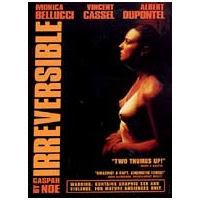
I've finally seen the infamous Frenchie film Irreversible starring the real-life couple Vincent Cassell and Monica Belucci. Yes, its as violent and visceral as all the critics say. The first 20 minutes will give you vertigo. Yes, Bella Monica is gorgeous in it. She has this scene where she sways her curvaceous body to rave music with bland skinny blonds who pale in comparison. Yes, the rape scene was very, very difficult to watch. My boyfriend couldn't handle it, and I was only able to get through the gruesome 10 minutes because I'd already known about this scene and I was watching through "technical eyes," wondering how they filmed it, the impeccable acting, the gorgeous lighting, etc. etc.

Its about an ordinary couple who were victims of a totally random crime, perpetrated by a sadistic fuck who wanders the streets of Paris. First he anally rapes her, taking particular pleasure in her pain and muted screams behind his restraining hand, and then bashes her face in the concrete floor. Over and over and over.

This film, curiously enough, showed the shadowy underbelly of the City of Lights. If monsters like that walked the beautiful parisian avenues, then equally monstrous beings must walk ours. The thought is frightening, especially as my work recently finds me in darkly-lit streets of Lito Atienza's Manila. That city gives me the creeps. Kalookan is a kiddie playground in comparison. I'd imagine horrible crimes happen under the mayor's brightly-lit smile. His face is plastered all over on cheap, ill-designed billboards.

I wonder, if human monsters, like the one depicted in the film, could only exist in a filmmaker's imagination. A day after having had those images indelibly marked in my head, I suddenly feel too...safe. And clean. As though I hadn't been sufficiently exposed to this city's filth that I would die of the first infection. I lead a relatively cocooned life, carefully screened off from this city's poverty. You and I, sitting pat in our gated villages, walled schools and guarded offices lead a pretty sanitized version of Metro Manila life. It doesn't mean the seedy underbelly doesn't exist. It must. Its out there, as greasy and as menacing as thin veil of grime coating every pavement, every building.

Monday, September 27, 2004

No More Fairy Tales

You are not my knight in shining armor. Not my savior, not my hope. Neither are you the tall, dark, handsome prince of my charmed, beautiful future. You could not hope to be one, if you'd so wanted. You have not the pedigree, not the airs, not the pomp and circumstance. You are not my dashing, debonair of a charmsman. Nor a suave Casanova versed in tricks of dinner talk and bedside manners. You are not the strong, silent, broken shell of a man, begging for my winsome healing strokes. A man of my girlish dreams you are not. A man of my teen-aged delusions you are not. A man of my imagination you are not.

What you are is my best friend in all times good, sad, bad, inane. What you hear in perfect understanding is my mind. What you are is my less than perfect lover in the sack. What you are is sanity and blessing and pain. What you do is make me upright when I am off-kilter. When the air congeals in my lungs, when the red doesn't flow smooth in my veins, when my heart pumps off-beat, then it is you I am missing. What you are is my complement. What you fit is the jagged edges of my puzzle. What you make is my life sweeter. And sour. And bitter. What you are is my love.

Tuesday, September 14, 2004

Ten Going on Thirty

Will you ever go back to teaching in that snotty school? My bestest friend stared back at me expectantly. No. The oodles of money they pay me to molly-coddle those rich bitches-to-be and those lazy in-need-of-sharpening little boys simply isn't worth it. Except for one. That ten-year-old I adored so.

Lance

I'd been warned, before he joined our class, of this little terrorist. He was disruptive in class. Manic. Short attention span. I'd expected a little monster, but I was pleasantly surprised. Sharp. Very sharp little kid. He knew what I was talking about the first time I explained French pronouns while the rest of the kids looked back at me with various levels of confusion. As expected, he got bored the second and third time I had to repeat myself. No wonder he's disruptive. He learns faster than the rest. How could the head mistress have missed this?

One Tuesday he hung back after I'd dismissed my Beginner's class. I was running late, but I thought he might want to talk.

"Hey Lance. That was a cool pic you drew. Do you really like tanks?"

"Yes."

"Strange though, are there always cigarette butts strewn around your living room?"

"That's the rec room. Yeah, my tito's."

"Your uncle lives with you?"

"Nah, he's my mom's boyfriend."

Dangerzone. It would probably be best if I steered clear of the Dad subject. Lance is playing with the colored chalk, leaving green and red marks on his white collar.

"Oh, I see. What about those magazines with the naked women on the cover?"

"Playboy? He leaves them out like that."

Asshole.

"Ok. Do you have any close friends here?"

"Here in school? No. They don't like me."

That's because they're snotty adolescent bitches and slow-learners who wouldn't get you.

"Why is that?"

"Because I'm fat."

"Nah, you're not fat. Just chubby. That's normal for a kid your age."

"Am too. They don't like me because I'm fat."

"Have you got any brothers or sisters?"

"Yeah. An older sister and brother."

"Do you hang out with them sometimes?"

"My sister's 26. She's married. And my brother's 23."

"Don't you hang out with your brother?"

"Nah. He's always out partying. He's like a vampire, asleep during the day and awake at night."

Ok. Absent mother. Absent father. Absent siblings and a pervert step-dad. Great.

"Oh. Well, have you got any friends in your neighborhood?"

"Sure. One. His name's Ryan. We play sometimes, but not often."

"So, what do you do most of the time?"

"I play computer games. I'm really good at them."

He'll develop great social skills for sure.

"Do you like our class?"

"Sure."

He finishes seat work at record speed. Then terrorizes his classmates. I can tell he likes my class. He shows up.

"Are you happy Lance?"

"What do you mean? Today?"

He stops playing with the chalk and looks up to stare at me, his smooth forehead wrinkled in query.

"Yeah. Today. Yesterday. Tomorrow."

"I dunno. I guess. Yeah, I'm happy."

"Ok. That's good."

He drops the chalk and dusts off his little hands. He makes a big show of standing up and dusting off his pants too.

"Mademoiselle? I've got to go."

"Alright. I'll see you on Thursday?"

"Yeah. Au revoir."

"Au revoir."

I'd wanted to talk more, but I'd sensed he was growing impatient with all the questions. Poor bright kid. The brave front he put up every day. Resident bad boy. Devil-may-care laughter. Arrogant swagger. Problem child. Problematic child. Heart-breaker of mine.

Sunday, September 12, 2004

Sa Canada

Ipinagtatabuyan na'ko ng aking mga kamag-anak at kaibigan. Bakit ba sa tuwinang nababanggit ang hirap ng buhay sa bayang ito, at sa tuwinang naririnig ako ng ibang mala-litanyang isa-isahin ang kung anong mali dito sa atin, laging ito ang solusyong naririnig ko:

"Eh di mag-abroad ka na."

Noong isang araw tumawag ang isa kong Tita na ngayo'y naninirahan na sa Canada. Siya, at kalahati ng aking mga kamag-anakan. Kamu-kamusta, chismis ng kaunti.

"Kailang ka ba magbabakasyon dito? Hindi naman natuloy, nung Summer dapat 'di ba?"

"Ay Auntie, kasi po may pasok na. At saka mahal ang plane ticket! Halos linggo-linggo nagtataas ang dolyar."

"Bakit kasi 'di ka na lang dito na magtrabaho?"

"Ay, Auntie, sa tingin ko kasi mas kailangan ako dito."

"Sabagay, tatatlo na lang kayo d'yan. Hindi mo naman pwedeng iwan na lang si Mama mo."

Bagama't totoong tatlo na lang kami dahil sa pagpanaw ng aking ama at lola nitong nakaraang taon, hindi dito patukoy ang nasabi kong mas kailangan ako dito.

"Saka, sa ngayon po wala talaga akong planong mag-migrate. Sa kinabakusan malay natin." Para lang matigil na ang usapan. Kung ipaliwanag ko pa ang tunay kong pinapatungkulan, baka di rin n'ya maunawaan.

"Tama yan. Bata ka pa naman. Sige magpasarap ka muna d'yan."

Kumunot ang aking noo at nagpanting ang dalawa kong tainga. Tama ba ang narinig ko? Magpasarap muna sa Pilipinas? Nahihibang na ba ang kaisa-isahang kong tiyahin?

Huli s'yang pumarito nung namatay ang aking lola noong Abril. Siguro nama'y sapat nang makita n'ya ang hirap ng buhay dito. S'ya at ang iba ko pang mga kamag-anak ay 'di nagkulang sa pintas at reklamo;

"Ay, sa Canada, hindi pwede yang ganyan!"
"Ay, sa Canada alam mo kung saan napupunta ang taxes mo,"
"Ay, sa Canada makakain mo kahit ano'ng gusto mo."
"Ay, sa Canada, walang trapik!"
"Ay, sa Canada may disiplina ang mga tao."
"Ay, sa Canada, safe maglakad ng gabi."
"Ay, sa Canada, 'di kurakot ang mga politiko."

At pagkatapos mas masarap ang buhay dito?

Friday, September 10, 2004

Scene Eh, You Row Pa?

I've seen a grand total of three Cine Europa entries, "Black Meteor" from the Dutch, "Sweet Nightmare" from the Portuguese and "Distant Lights" from the Germans. The verdict? They all suck. This was supposed to showcase the best in European film right? Wrong.

The Cine Europa this year is a political statement. Nevermind the quality of the film, as long as they fit the general themes. Which themes you ask? Europe is a multi-cultural amalgam of nation-states, not exactly a coherent socio-political entity, but one working in harmonious cooperation. Europe is not xenophobic. Look, we welcome black soccer players! Europe does not condone racism. Europe is sympathetic to the immigrant's plight. Europe welcomes skilled, hardy foreigners. Europeans are more and more aware of being in a "union." Europeans are mobile within the EU. They even inter-marry! Europeans are investing in each other's countries. Especially in more economically depressed areas! Europe is being invaded by American culture, look at how crass and "baduy" we've become!

May this year marked European enlargement. 10 new states (central and eastern europe) are now official members of the EU. Europe is now 500 million strong. A huge market, obviously an economic powerhouse that seeks to rival the Yanks. What does this have to do with a film festival you say? Who said politics didn't use culture and culture politics? They are one and the same.

Thursday, September 09, 2004

Wednesday, September 08, 2004

Diagnosis: Critical Condition (Or Why the Filipino Film Industry is in Deep Shit)

The Art Muses seem perverse in humor. Just as the local film industry breathes its last breath, foreign film festivals proliferate. How many have there been this year? Ok, let's enumarate shall we? (Those that I know of, of course.)

1. June. French Film Festival. Showy Frenchies like making big cultural splashes. And the film fest is the crowning glory of a month-long cultural celebration. They charged P50 pesos (I think) per film. Still cheaper than SM's P60.

2. July. Cinemanila. Hugely successful almost month-long festival which showcased some 20 foreign films, the epic-in-length Lav Diaz flick and the controversial "Imelda." My boyfriend and I shelled out P600 a piece for six films. Hard on the pocket but well-worth it.

3. July-August. Italian film fest. Screenings on Tuesday nights at the CCP dream theater. Its a small venue, but always packed.

4. July-August. Pink Film Fest. Haven't seen any of the entries. Shown not just here in Manila but in Cebu and Davao as well.

5. September. Cine Europa. Fourteen european films screening at the SM Megamall. Will also be shown in Cebu and Baguio Admission is free. I've seen "Black Meteor" and
"Distant Lights" so far. Germanic films that sucked big time. I will stick to Romance languages. Passion, intensity, similar Filipino temperament. Los Lunes al Sol and Les Choristes should be good.

While Manila residents are having a field day sampling film fares from all over, Filipino films attract flies instead of patrons. Even Bold Films aren't making as much money as before, and so SM Cinemas made the business move not to show them anymore. (No, not because they are bastions of morality and high standards all of a sudden.)

I think local producers should get a clue. People with extra money to spare for entertainment want to see films, not porno. Or the usual run-of-the-mill romances and comedies. What else explains the sudden demand for film fests? These are obviously hard times, and there is a widely held belief that "artsy-farsty" films don't make money. Precisely the point, with ordinary folk squeezing their budget as far as it would take them, they'll prioritize necessities. Not entertainment. And besides, they can always purchase that P30 VCD from the friendly neighborhood pirate.

Tuesday, September 07, 2004

Paglalayag

Takda ng ibayong panahong
Pagtagpuin kamalayang uhaw
Sa pagkalinga't kagalingan
Sa kalayuan ay natanaw
Na makadaupang palad
Ang sa layo'y di masukat
Damdami'y naglalayag
At patuloy na dumadaloy.

Na akuin ang hindi ukol
Na libakin ang kapalaran
Mga balakid ay isantabi
At panandaliang kalimutan
Ang malao'y di gamay
Kinabukasa'y panaginip
Ngunit patuloy na naglalakbay
Naglalayag na pilit.

__________________________________________

Sa kabutihan ng loob

Sa kabutihan ng loob
Dakilang nilulukob
Ang sakit ng iba'y pasanin.
Sa kung hanggang saa'y dadalhin,
Kahit na walang sinsakit, pipilitin.

Sa kabutihan ng loob
Dalisay ang tao,
Malaki man o maliit
Bobo't matalino,
Pantay-pantay ang pagtingin,
Kahit iba't iba ang saloobin.

Sa kabutihan ng loob
Tiwala'y walang patid
Palalagpasing pilit
Lahat ng pagkukulang.
Samantala'y dito nalalaman
Kung ano't sino ang mainam.

Sa kabutihan ng loob
Hinihinang ang lakas
Sa bawat sakit na pinalalagpas
Pag-unawa sa sarili't iba'y lumalawig.
Tibay ng didbib at pag-unawa'y nag-aanib
Pinsalang dulot ng tadhana'y pinapatid.
Sa kabutihan ng loob.

Sunday, September 05, 2004

Confessions of a Bibliomaniac

I've acquired an addiction. One that I know wouldn't quit because I had once thought I would steal to keep on feeding it. I had dreamt of what fun it might be to be invisible so that I may acquire as much of my drug-of-choice as I needed. I'd dreamt of raiding bookstores. National Bookstore, Powerbooks, Fully-Booked, Even Books-for-Less and Booksale. I had thought of ways to execute this crime (what to wear, choice of get-away vehicle, shoes) in order that my theft might avoid detection, having CSI agents in mind. I am becoming a book addict.

No, now that I look back on it, this addiction has long been in the making. It started when I was 10 years-old. It was fashionable in my fourth-grade class to read. The choices weren't all that many; Sweet Valley Twins, High and University, Hardy Boys, Nancy Drew and Sweet Dreams. These were the mainstream choices among other 10 year-olds in my all-girl school. Much as I might like to claim I preferred the young super-sleuths to blonde bombshells-in-the-making, I cannot. There was something uncomplicated and pleasant in the travails of pre-pubescents' angst about boys, peers and their parents. I like Sweet Dreams too. My first copy I had bought because the main character had my first name. Sweet Dreams shaped the way I looked at boys and my general knowledge of them, I must confess, rare species as they were in my All-Girl universe. If I had known then what I know now, I'd have stuck to sleuthing.

I'd collected dozens of these books, but like any book junkie, I thirsted for more. And so, I "diversified." I believe I was in fifth grade when I discovered Christopher Pike. Master of horror novels for the young, I was attracted to Pike's kind of morbid. Murder, ghosts, psychopaths and aliens were introduced to me by this juvenile version of Stephen King. Many a night I'd quivered in fear and hyperactive imagination. I loved Pike,but growing older tends to inhibit suspension of reality. And so, I moved on to "older" material.

I was 12 I think when I read my first historical romance novel. Yes, the kind with half-naked people on the cover. Ah, the joys of sex between two caricatures in an imagined historical setting in far-away lands. This was how I learned about the birds and the bees. I fed on relationships between stereotypes written for female consumption to ensure maximum romantic satisfaction in lieu of "real" relationships.

This was how I learned about love. I was hooked. And all through highschool I lived and breathed Judith McNaught, Johanna Lindsey and Amanda Quick. I was a princess, a dutchess, a lowly servant-girl who consorted with titled, aristocratic, dark-haired men who were stoic, virile and thoroughly "masculine." These men substituted for the minisucle number of boys I encountered in my real world. And so I believed men were honorable, principled beings with an almighty penis to satisfy my budding female urges. Alas, reality is a slap in the face when it comes to the men in my life. They are far from the noble, gentle knights of my girlish imaginations. Real life had finally caught up and I grew older, supposedly wiser, leaving my romances behind.

College introduced me to books that shaped and continue to shape my brain's synaptic activities. Landmark titles are Global Capitalism by Richard Peet, a Marxist. I picked his book randomly from the OPAC list of the UP main library because my Polsci 11 teacher asked us to pick among three choices on which to write an essay; War, Capitalism and the third I can't remember. Well, you know which one I picked. I suppose, more boys than girls chose the first one. I had no interest in the logistics of human evisceration. And so, completely by accident, I discovered I liked political economy, of the international sort. And of the "radical" kind. That book started it all. No professor, no indoctrinating activists. Just a single book.

My choices of books have since left the imaginary realm to dwell on "real" events and theoretical paradigms that explain and analyze them. I still occasionally purchase "in-between-ears and thighs candy" readily offered by the likes of Linda Howard and Patricia Gaffney. The writing is marginally better than my teen-aged choices, but still follows the romance formula. The fiction classics I've read can be counted on one hand. I am woefully ignorant of Gabriel Garcia Marquez or James Joyce or Brett Easton Ellis. Of pop authors I've heard Murakami and Palahniuk are gaining cult following. I've seen Fight Club, but that's about as close as I'm gonna get to entering Palahniuk's postmodern imaginary. I prefer to read postmodern socioligist/philosopher Jean Baudrillard instead.

And so throughout the years my bookshelves have continued to burgeon conversely with my eye grade. God help my poor irises, for they must be sacrificed on the altar of my addiction. I am ready to make such a sacrifice. What other explanation is there when one gets so giddily delighted by booksales and rare-book finds at bargain prices? What other explanation is there for the happiness and well-being that ensues after each quick book-gratification? I am a bibliomaniac. Does it have to do with the hubris of accumulating knowledge? Maybe. Does it have to do with "The more you know the more you don't know?" Maybe. Does it have to do with stocking up on a social capital that doesn't have anything to do with the numbers 36-24-34 or straight hair or a properly sweet demeanor? Maybe.
_____________________________________________________________________________________
Speaking from the soul, head and gut.
De l’âme, de la tête et de la foi
Mula sa saloobin, sa isip at sa panalig

Je suppose, quand nous sommes chargés avec le complexe messianique, nous croyons que le monde n'aura pas aucune possibilité d'avertir la fin sans nous. C'est arrogant. L'orgueil se réverbère. Mais l'histoire montrait les hommes et les femmes effectuant des changements mondiaux en toute autonomie. Fin, je suis une de ces personnes-là. Toujours rêvant des moyens qui basculeraient les quatre colonnes fixes sur lesquels tout le monde reste. S'ils étaient capables d'avoir joués le rôle du messie, pourquoi pas moi?

I suppose, when one is inflicted with messianic complex, one tends to think the world could not possibly escape Armageddon without her. It is arrogant. It is self-important. I am guilty then. Of dreaming of ways to unhinge the world from whence it is pegged. History has shown men and women single-handedly change the face of the earth. Why shouldn't I be one of them?

Marahil sa panalig na lahat ng sangkatauhan ay karapat-dapat salbahin, ika’y nagtataka na ang daigdig ay nagpatuloy na uminog nang wala ka. Anong pagmamataas. Anong pagmamalaki. Ngunit hindi ba ang kasaysayan ay puno ng mga nilalang na sa isang lakas ay gumuhit nang kapalaran ng sandaigdian ? Ako’y nagnanais na gumuhit din. Hindi pa nagsasawang managinip nang gising na ang pakay na ito’y maisakatuparan. Kung ang tulad nila’y nagpunyagi, bakit hindi ako ?

Friday, September 03, 2004

Superducks and underducks
by Eduardo Galeano

EVERY day we spend $2.2bn on killing each other....

The five largest arms producers are the US, Russia, China, the United Kingdom and France. They are also the countries with a veto in the United Nations Security Council. It insults common sense to make those who provide the world’s weapons the guarantors of world peace...

These five countries are in charge. They run the International Monetary Fund and all (except China) are among the eight countries that take most key decisions at the World Bank and the World Trade Organisation, where the right of veto exists but is never used....

Ah, the depressing things you learn about the world huh? Want to read the rest? Click here

Monday, August 30, 2004

What Damaged Culture?

Our culture is a damaged culture. I remember hearing this from my social science teacher back in high school. And since I was a kid and didn't know any better, of course I believed her. I'd since forgotten that day, that lecture and this term "damaged culture." But I'd retained the idea, most likely subconsicously. So all these years I was walking around with this mantra drumming in my head:"We are a damged culture...we are a damaged culture....we are a damaged culture...."

Then this term was resurrected in my universe of consciousness when I took Anthropology 225 under Professor Dacayanan. There are as many definitions of culture as there are writers she said. Among those she mentioned, this is what stuck to my head. "Culture is a tool for survival." Meaning, a culture of a particular grouping evolves to ensure its survival. To ensure that the grouping as an entity continues on (and does not
disintegrate i.e. Yugoslavia or disappear entirely, err...Atlantis?).

Recently I've encountered this term again in Julsito's and Doc Emer's blogs. It irks me so when I see fellow Filipinos describe our culture as such. Can we say ours is a "damaged" culture? I don't think so. Why? Because:

1. It presupposes we had an "intact" culture beforehand. And something or someone along the way went and broke it. Pray tell, who was this breaker of cultures? Spaniards? Americans? Japanese? Ourselves? And before these invaders came? Was there an intact "Filipino" culture? Were our ancestors calling themselves Filipinos? No, they were calling themselves Ibanags, Ifugaos, Tausugs, Hiligaynons, etc. etc.

2. It presupposes that other cultures are undamaged. What, pray tell, is an intact culture? The Americans'? What with thousands of immigrants coming in every day bringing along with them their own unique cultures? What about Greeks back in the classical era? No, wait, they were killing each other then too. And so we can't really say theirs was an intact culture. Not to mention the fact that the Greeks have inherited much from the Egyptian culture, who in turn were influenced by the Mesopotamian cultures.

Can we say the Western Europeans have an intact culture then? No. Because Western European history goes well beyond basing their civilizations on Greeks. As I said, Greeks trace their roots to the Middle East.

The point here is, cultures evolve and whether the evolution is judged "good" or "bad" is subjective. A culture is a way of life. And if our culture today means under-the-table deals, graft and corruption, crab mentality, then there was a reason for this. This culture didn't appear out of nowhere. And it is not a natural state of being.

Government is corrupt. It is self-serving. It is inept. We all know this. But then the culture of government in the Philippines has never been concieved of and practiced otherwise. Government is a pact between a people and a State. The People give up their rights to State for the latter to protect the former. Provision of public services, ensuring peace and order etc. etc.

But then Government in the Philippines for over 350 years was never meant to be a pact between people and State. There was no people. And there was no State. Government was simply an institution to assure the smooth running of a Colony, to extract economic resources as efficiently as possible without rebellions from the subjugated populations and such.

And Government was also seen as the quickest way to move up the social ladder. And so, civil "servants" joined Government to enrich themselves and not to become purveyors public service.For three and a half centuries this was the culture of government.

What about such self-hatred from Filipinos themselves? Filipinos who are so self-critical? Filipinos who denounce their citizenship abroad? Filipinons who would rather the Philippines become an American state?

Well, if you'd been told over and over in the past that you and your culture is no good, inferior, backwards, why should you think otherwise? Eventually, you believe the mantra. And if you yourself use foreign standards with which to measure your achievements or shortcomings, what other conclusions will you end up with?

We should have a new mantra drummed in our cerebrums. We need a change in culture.

"We need a cultural revolution...we need a cultural revolution...we need a cultural revolution..."

Saturday, August 28, 2004

Death Crisis Anyone?

I went to the press conference held by the economists who made the paper "The Deepening Crisis: the Real Score on the Public Debt" yesterday at the School of Economics in UP. There were a handful of print journalists, I saw channels 2 and 9, but the rest were probably groupies and students of the econ profs. There were seven of them, three of whom I recognized as Winnie Monsod, Benjamin Diokno and Felipe Medalla.

The numbers were indeed alarming. The ones that stood out were the "financial risk indicators" emphasized by Mr. Diokno. Replying to the query, "So how did we get here?" he showed us some figures from 1999 to 2003.

In 1999, 26% of our budget was set aside for debt interest repayment. In 2003, this rose to 46.2%.

Thats right folks, of every P100 of your taxes, half goes to debts neither you and I had incurred. We were never consulted about it, we had no hand in it, we had no choice about it. What a democracy huh?

Another risk indicator was the Debt to GDP ratio. In 1998, 56.1%. In 2003, it was a whopping 77%. The IMF's recommened reasonable level for developing countries is only 30%.

One lady economist (whom I didn't recognize), said capital inflows in the Philippines were considerable lower than our neighbors. Which basically meant investors are shying away from us. Maybe because theres too many transaction costs incurred due to...red tape? Corruption? Under the table pangongotong?

On the IRA (Internal Revenue Allotment), the national government shells out P35 billion pesos annually to local government units. The IRA was instituted in the waning years of the Aquino adminstration and was finally approved in 1992. LGUs might be complaining about having their IRA slashed, or worse abolished in the name of "austerity," but Diokno pointed out there is an escape clause to the IRA, meaning the government has the prerogative not to release it.

On the Congress' pork barrel (sweetly couched as Countrywide Development Fund), Diokno said we should keep an eye on re-election senators because they will clutch their pork barrels to their chests like theres no tomorrow. They will need that extra fat for the 2007 elections.

Queried about the rumors about taxing text messaging, Ms. Monsod, decked out in a lovely orange suit, engagingly said their proposed measures had a sequence. It was careful to firstly, target the executives and the powers that be in the land and so on down the line.

The medium and long-term proposals in the paper are the following:

1. Downsize the bureaucracy. I think this has merit, seeing as there are so many redundant offices, not to mention "ghosts" bureaus which receive budgets even when its doing absolutely nada. (You notice that Visitor's Information building along University Avenue?)

2. Privatization. This proposes selling government owned and operated corporations, especially those where the government has no self-evident role to play. I have reservations about privatization, especially of public services, but the economists were careful to make the above qualification.

3. Rationalization and reduction of tax incentives. An estimated P175 billion is lost due to tax breaks on certain business sectors. Gawd, there is such a thing as "lobbying" (It should be called "lining the pockets" instead) and I'm sure these businesses have set aside cash to add to their powers of persuasion.

4. Politicization of prices and of the regulatory system. Mainly, government-owned operated services shouldn't give in to popular pressure against power rates, the metro train rates and toll fees (among others). Let the invisble hand of the market decide. Personally, I don't believe in this infamous hand.

5. Spending efficiency and the tax revolt. Government should be careful about what they ask of their citizens, especially if tax payers see their money squandered and misappropriated. On escorts like Keanna Reeves maybe? Or on gas-guzzling SUVs?

6. Rationalizing national-local government fiscal relations. Pertaining to the IRA I mentioned above. This basically means local government units should no longer wait for a dole out from national government. LGUs must then try to make money on their own, making mayorship, for example, a lot more...demanding and would require incredible managerial abilities. So people, should IRA be abolished, think twice before you vote for the likes of Jinggoy or Lito.

Angsty you say?

I believe this report is disquieting as it fully reflects our supposed sovereign nation's lack of self-determination. Here is the abstract notion of a "debt crisis" (which really means international creditors, and the World Bank-IMF) hanging over our heads, making us undertake "austerity" measures.

I have no beef against disciplining the bureaucracy and cutting off unnecessary expenses, but the point is, we're doing all of this so we can pay of our debts? Which have ballooned because government officials and their unaccountable technocrats
have continued irresponsibly borrowing througout the years? And because the peso has continued to devalue due to "vagaries" of that nebulous financial world market.

I was born into debt. You, your brothers, your sisters, your cousins, your parents, your children and grandchildren to be. We had no hand in incurring these debts. They just magically appeared in our midst. And we call this country a democracy?

Would that I could do a tax revolt, but sadly, my taxes are automatically taken out of my measly salary. Now you understand why I'm so angsty about the future. It seems the end is near. I'll go watch Marinara now. Or start playing Ragnarok.

Thursday, August 26, 2004

Great Toilet Book: About Men Part 2

On having a Penis


The difficult truce between sons and fathers proceeds from both recognizing the importance of what they have in common: a penis. This simple fact is what makes all men “like” each other and all men “different” from women. Based on this fact, men come to share a belief that women are not really human beings. This belief is so crucial and so deep that it remains psychologically “invisible” to both men and women. For a number of reasons, both men and women either deny having such a belief, minimize or confuse its importance, or claim to “prefer” its hidden advantages.

The consequences of this belief are enormous. By recognizing that all men possess penises and by declaring that this is the root-sign of both humanity and true divinity, men may wince at the pain or humiliation inflicted upon other men, but not at the pain or humiliation inflicted upon other women. This deification of penises allows men to not experience female suffering as representative of human -- and therefore male – suffering. Female suffering is thereby condoned as less pertinent, less significant, less threatening than the pain which befalls men.

For example, men are horrified at the forcible anal rape of another man. But they are much less horrified at the anal or vaginal rape of another woman, especially if she is not a female relative by blood or marriage. Also, most men experience any and all expressions of female emotion as overly intense and threatening, as a form of attack, as an attempt at female control. Women are often stunned by the rigid disapproval, the contempt, the sadism that men display of female tears, of verbal demands and complaints.

Most men are respectful of female suffering at childbirth -- but not identify with it. Or as physicians, they frequently treat it sadistically. By comparison, women are both respectful of male suffering in all male economic or military wars and also identify with it as a human hardship or tragedy.

It is because men believe that women, creatures-without-a-penis, are not human beings – that women are devils or angels, goddesses, or whores – that many men do have a genuine urge to “protect” women. They “protect” women into corners where the harm they may do men is at least limited.

It is because men believe that women are not human beings that so many men are genuinely perplexed by, removed from and cannot identify or empathize with female “complaints” of unhappiness, paralysis, disappointment or anxiety.

Women, of course, have an equally difficult time really understanding male needs and are often contemptuous of the male need to be “taken care of” and “constantly agreed with.” But women have been taught to value whatever men value and need – even though it hurts or confuses them as wives or as women.

Among men, the presence of a penis is still proof of a shared humanity, still the proof of truce between father and son, however uneasy a truce it is. It is still the trigger for mae-male empathic identification. Thus are adult men always comparing themselves to other men: on the basis of penis-size and physical strength. They always feel the need for male “truce,” no matter the price. It is a transaction they have made once before. With their fathers.

Sons originally experience their “smallness” in terms of how small they – and their penises – are in relation to their fathers. The male idea or fear of being sexually castrated must involve some early fear of fathers doing this – as much as it ma be “triggered” by contemplating the absence of a penis in the castrated mother, and in all women.

Remember: one interpretation of the Patriarch Abraham’s willingness to sacrifice his son Isaac and the consequent substitute ritual of circumcision is that male gods and fathers can kill or castrate their young and even beloved sons, but can also choose not to. Men talking about castration anxiety seem to experience it, or associate it, with prolonged or intense heterosexual intimacy. Too intense or too “merged” a contact with women reminds men of their parent-without-a-penis who couldn’t or wouldn’t protect them from the parent-with-a-penis.

Men, upon being questioned about “castration anxiety,” either report having none – or immediately start telling me about how they fear being “castrated” by mothers and wives. They rarely mention fathers or other men. The silence of male truce runs deep; the fear of fathers is displaced onto mothers and surfaces in anecdotes about “castrating” women.

Men, upon being asked about their penises (not castration anxiety), often respond at first with a bristling, overwhelming concern with “size,” with “quantities,” and with “visible proofs” of penile activity. A thirty-one year old man said: “I can still have five erections in one session – especially with a new woman.”

Many men responded to this question by telling me that “penis size isn’t really important,” but tell me how “lucky” they are to have a “good-size” penis. When asked about having a penis, a fair number of men talked about “how many more orgasms women can have compared to a man.” At least ten men referred to the “female use of vibrators,” within five minutes of being asked about penises.

This particular pattern, of male focusing on female sexuality when asked about their own, this particularly aggressive insecurity, occurred repeatedly when I tried to talk to men about having a penis. It does seem related to male uterus-envy and, perhaps, to a newly awakened fear in men based on recent “discoveries” about female sexual capacities (multiple orgasms).

Absurd as it is, men tend to use male sexual behavior as the referent for human (sexual) behavior. Men assume that if women were as “free” as men given their supposed sexual insatiability, they’d behave sexually like men, i.e., fearfully, promiscuously. If men were not terrified of being found inadequate by the designated biological inferior; if men were not frightened and jealous of woman’s reproductive capacity; if men were not disgusted by female sexual needs or demands – then female sexuality would not be so cruelly exiled into colonies of (sexuality) undemanding girl-brides and girl-wives, or into colonies of (sexually) undemanding female prostitutes, concubine, or slaves.

When men posit sex, violence and death as elemental erotic truths, they mean this – that sex, or fucking, is the act which enables them to experience their own reality, or identity, or masculinity more concretely…and that death, or negation, or voidness, or contamination by the female is what they risk each time they penetrate into what they imagine to be the emptiness of the female hole…Each time he survives the peril of the female void, his masculinity is reified. He has proven that he is not her and that he is like other hims.

Since the penis is the proof of male existence, the proof of male power, it is too important and too vulnerable an organ to be exposed publicly – especially to women. While female nudity is everywhere exposed – in great art, in mass pornographic propaganda – male frontal nudity is relatively taboo. What if women began comparing the penises of aging husbands with those of younger, more beautifully shaped men? How could a man bear being compared, once again, by a woman, with another, “superior” man?

Tuesday, August 24, 2004

AbsurdiTV

If television is the modern opium of the masses, then our people today must be drugged beyond the absurd. Have you seen prime time TV shows lately? 4 to 5 solid hours of brain-frying hallucinogenic experience. And since there are two major stations airing them, then that makes 8 to 10 hours total. Whew. Who needs X when you've got GMA-ABS-CBN?

At first there was the phenomenon of Mexican soap opera imports (Marimar, Maria del Sol etc.). What could be more surreal than blond hispanics mouthing Tagalog? But anyway, Filipinos took the bit because there are talking dogs, beautiful babes and the well-trodden story arc of the poor and oppressed young woman winning the battle against big, bad, rich usually older woman by marrying the young, dashing, rich young man.

Beautiful But Oppressed hails from the hinterlands or some other rural area toiling away at the fields. Meets Dashing Rich Debonair on vacation. The two fall in love and would live happily ever after if not for the Older Baddie. And so the requisite insult-hurling, cat fighting, and not to forget Big Time Oppressing (for no apparent reason but for the sheer evil of Big Baddie) must lengthily unfold before our eyes before Beautiful But Oppressed learns to fight the dirty fight and finally triumphs over Older Baddie. Its easy enough to see the box-office appeal of these agalog-speaking hispanics, their soaps could have been local if not for the "better" looking actors.

Local soaps usually make the same juxtaposition of the Poor and Oppressed in the rural areas being treated cruelly by both Destiny (as though it were a given that, well, they're just poor period), and the Rich from urban Manila. Its a cheap play on modernity vs. tradition, town mouse and country mouse but its a hit for the masses (and some from the non-masses) because it must strike on similar cultural sensibilities.

Isn't it a cultural given that everyone wants to be rich? Isn't this the ultimate goal of each and every Filipino? And musn't he or she do everything humanly or inhumanly possible to achieve this? If you happen to be a nubile young woman, well then, the way to do it is snag yourself a rich young man. Nevermind getting an education. Nevermind entrepreneurial ingenuity. Nevermind working your ass off at the work place. You just need to work your ass.

And then came the imported tsinovelas (Meteor Garden). The storylines don't deviate much from the lowest common denominator of young woman oppressed (either because she's poor or just because she's female) and in financial trouble. She may be maltreated once in a while by her significant other but that's OK, because this is the normal male-female dynamic. Young men must be brash, arrogant and showy while young women must be timid, giving and self-effacing.

The similar theme of the suffering female is the cornerstone of every single soap opera in this country (imported or not). Tears flowing from women's eyes must be more precious, more tragic. Be they humans, mermaids or mutant aviary escapees. Household pets no longer corner the talking-animal niche. Crustaceans and varying winged-creatures are now in on the market share. TV is indeed getting more absurd if prime time is a barometer. This is escapism beyond the escape. Its as if we tune in to the idiot-box to enter the universe of scripted lives because we know, that in the end, there is only happy ending.

Why would you want to live and see the real world when it has nothing good to offer?