Great Toilet Book : About Men Part 1
If you’re like me, you take your time in the bathroom doing your business because you read while relieving yourself. Aside from the paper, there are books that simply beg to be read while shitting. This one, written by a psychologist named Phyllis Chesler entitled About Men, I find altogether amusing but makes sense in a disturbing, sick way. It seems she overdosed on Freudian theorizing and peppers her writing with psychosexual gobbledygook (whatever that is). I bought this some months ago at a rummage sale in the UP Faculty Center for 10 pesos I think. Now don’t go asking me why I bought it, it’s none of your business. Anyway, while unearthing some papers buried in my own personal Smoky Mountain, I rediscovered the joys of this toilet-book yet again.
Fathers and Sons
What do sons feel and remember about their fathers? From the psychoanalytic point of view, a man’s first woman, his mother, is taken from him by his father; and his second woman, the mother of his first son, is taken away from him by his son. Not an uneasy rivalry to live with, and yet an uncanny silence surrounds this drama. Sometimes, the silence is broken by Oedipal claims of omnipotence and revenge—“I’ve really gotten even with my Father. He can’t control me at all.” Sometimes the silence is broken by emotionally wild expressions of anger and contempt for the mothers and wives involved. Much less often, if at all, do we hear sons pierce the silence with public, verbal accounts of their emotional relationships with their fathers.
It is women, in private settings, who most often share men’s memories of having been belittled, criticized, not taken seriously—patronized—by their fathers. Unless men have a reason to praise their fathers, they usually remain silent about them in (male) public.
Upon being questioned, men are mildly and surprisingly amnesiac about what occurred between themselves and their fathers. Men usually find it hard to tell me much about their fathers. They tell me what kind of work a father did. They tell me whether his life was “hard” or “easy.” They tell me what country he came from, and whether he’s still alive.
Upon being questioned about their fathers, many educated men immediately shift into “theoretical” discourse. “Marx believed,” “Freud said,” “Obviously Nixon thought,” “Research on apes has shown.” Anything, anything is safer, is preferable to talking about themselves in relation to their own fathers.
“Did your father ever beat you?” I’ll ask. And in response most men immediately discuss male violence in the abstract, male violence on some other continent, male violence as other men practice it on other men. Not as they practice it. Not as it was practiced on them.
Among men though, there are crucial and unique advantages to be gained in accepting or “resolving” the father-son relationship. If sons are adequately socialized into patriarchy, they can then “bond” with other men for economic gain. Also, they are prepared in rejecting identification with their mother, for a life of “male” work; they are also able to enslave women and other men with only moderate degrees of guilt. These advantages are not spiritual or emotional ones. Men are not taught how to be interpersonally sensitive to others—or to themselves. Despite male egotism and narcissism, most men tend to lack the emotionally introspective tools that would allow them to comfort others or comfort themselves.
There are “good” fathers and “good” mothers; but let us admit, even if the admission angers, frightens, or shames us, that while “good” people do exist, they are a rarity, a miracle, a blessed exception. Unfortunately, the Parents of the human race are not “good” people: not always, not all the time, and not often enough.
It was startling to hear men respond to a variety of questions about their fathers with “sexual” information about themselves. For example, at least two men responded to the question “Tell me about your relationship to your father,” by telling me, abruptly, aggressively, defensively—bizarrely—all about “sex.” They said: “I’m a highly sexual man,” or “I masturbate insatiably,” or “I’m pretty sadistic sexually to women—but it turns me on and they have no complaints,” or “I’m afraid I might be a homosexual,” or “I’m a happy homosexual, sexually speaking.” All this in response to a question about their fathers!
As if they wanted to warn me off this topic. As if the father-son relationship somehow demands a genitally sexual solution—a solution which civilization prohibits.
Afterwards the thought of this strange possibility made me wonder to what extent traditional male homosexuality is related to a desire to solve the psychopolitical war between father and sons. Or to a desire on the part of men, especially recently, to defuse the escalation of male-male rivalry by eliminating women as a basis for competition.
Patriarchal civilization is, from one point of view, a male homosexual civilization. Women are valued only for their reproductive capacities. In all other areas, men prefer to remain separate from women, and in close contact with other men. A culture that covets such separatist all-male control of religious, military, economic, and political institutions is, psychologically speaking, a homosexual culture.
More and more as I listened it seemed many men had the same father. All fathers began to merge into one man, one father-archetype: a shadow-stranger, part tyrant, part failed tyrant—pitied for the failure; an awkward man, uneasy or out of place at home; a tense man, not in control of his emotionsl; a man remembered for blinding suddenness of his violence, for the blinding sweetness of his unexpected tenderness; a man of childish pettiness and of extraordinary generosity.

Tuesday, August 24, 2004


Saturday, August 21, 2004
Caffeine and Nicotine Talking
Seated here in my corner in a posh coffee house, drinking my overpriced cafe latte and smoking my kreteks, I am reminded of this conversation I had with Luis, in another cafe of the humbler type. I suppose many people our age, suffering or about to suffer quarter life crisis, have had similar conversations. We were talking about, among other things both mundane and not, the insecurity of employment. He, an artist, and I an educator, were worried about the future. He said he was flirting with the idea of going back to school for further studies. And I, well, I was wondering whether I could independently live off of teaching younger people how to think.
What went unspoken, although we skimmed on this topic before under the rubric of "making a difference", was whether we could make something more of ourselves and make a "mark." Oh the unspoken arrogance of it. Is there a place for people like us? Maybe we made a mistake in pursuing our passions and walking on the path our talents have shown us. If money is the only concern, maybe getting an MBA would get us better financial rewards. I don't know. Perhaps, but for me it would mean selling my sould to the devil.
Strange thing is, in this society, people like him and I are not usually well-rewarded for the things we like doing. Those of you who know him (and even those who do not) would probably peg Luis as a person of considerable talents and capabilities. Should this equate to "success" then? And along with it the moolah? Who knows? What went unspoken was, "We should become successful in whatever it is we choose to do because we are 'more able' than most." Sadly, in this society, one cannot rely on the comforts of having more "capacities" than others. Would that our degrees could assure us of "making a difference."
So the future hangs over our heads, all us young people, a nebulous dream of greatness and prosperity of equal value as our "gifts." The fear of failure is very real. I asked him something like "Do you think you can make it?" and he said something like "With hard work, sure." Would that it be as simple as plucking a ripe fruit from a tree.
Friday, August 20, 2004
Male Show / Parade of Synapses
A concatenation of male voices,
Raised in high pitched shrieks,
Seep through the sealed consciousness
Of everyone within hearing distance.
Decibels vibrate in resonance
Echoing off the walls of privilege.
These male voices compete
Against each other in battle.
Which voice dominates whom,
Which shriek echoes loudest?
Male power in exhibition, in combat
Pornographic in proportion
Exhibitionist in show.
_____________________________________________________________
Parade of Synapses
The procession commences
In agonized precision
They walk in a long column
Of fragmented brotherhood
Seeking redemption somewhere
Down the road of greatness
The procession seethes
Pulsing with life it struggles
To reach that sacred plateau
In the faraway horizon
The procession marches
Precise destination unknown
Hands linked in fragmented solidarity
Playing music,
Fingers playing at keys of life
Unlocking heaven, earth
And that in between.
Tuesday, August 17, 2004
Travails of Pleasure
As I sit here in this cool cold den of fakery I am amazed and disgusted by such wastage. This youth, this energy, this idle time consumed by empty pursuits of fake smiles, pretend conversations and illusions of destination. Why must youth be devoted to the fulfillment of self-satisfaction as though one's life depended on it?
Why must we devote so much concentrated effort on entertaining ourselves? Show me the new book, the new movie, the new video game, the new CD and the new coffee house within which we may spend hours upon hours to discuss the minute and intricate details of each. And after which we may all go our separate ways smug in the knowledge of the empty. We lay on our beds and dream of yet more ways to satisfy our hunger for nothing. So much trouble, such hard work for pleasure.
Show me the cool way our generation speaks and I will master each linguistic turn and slight of tongue. Show me the new club pulsing with the unique generic music of fake artistry and I'll dance the same familiar grooves. I'll shake my bootie to disappear within and amongst the ambiguous swaying mass of other disembodied bodies. Show me the newest smokes, the latest clothes, the coolest fads and I'll suck 'em and wear 'em and ride 'em hard and strong for this is what my youth must rest on. Such arid emptiness in this cool cold desert of the young. Is there nothing else? Can no one show me the exit?
Monday, August 16, 2004
To Solitude

Like an old mistress from the past
You return.
Casting light in my shadows,
You come
To hold me companion.
Your ghostly hands,
White, pale in luminescence
Embrace me tight.
I shut my eyes
And bask in the radiance
Of your cold burning fingers.
They pierce me alive,
Urging me forth
To capture the self
I've abandoned.
Street Life
Little children play
At adulthood
Skipping mirth, shirking innocence,
They plead rescue.
Gnarled fingers, twisted eyes
Little demons chasing
Away evils of their own.
To the streets they come
And play little children
Hiding within bodies young
Gazing with old unwisened eyes.
Sunday, August 15, 2004
On Reason
It is said that consciousness distinguishes humanity from the rest of the world's inhabitants. It is because of reason that we are humans and are supposed masters of our destiny. If this is so, then it means we are wholly in control of our lives, and all human activity would amount to a state of being that is relatively pain-free.
In all of humanity’s 250,000 year-old history, our struggle for this pain-free state seems constant. And despite of supposed advances in technology, of our mastery over the forces of nature that once could obliterate us without malice or mercy, human suffering remains. Why?
If it is indeed true that it is our reason that causes us to question the world and how we fit in it, if it is true that all of human activity seeks explanation that such causes such, why have we not ended the causes of many human problems?
Because as we grow old, our views and beliefs cease to expand, grow, change. We, objects of history, resist change and become fixed. Fixed in our thoughts, secure in our knowledge of what the picture of the world is like. It is flat. It is the center of the universe. It is the masterpiece of God the Father. Saying otherwise, is deadly. Why is there such fear in the radical? In the potentially destabilizing? In questioning the status quo?
Is it due to pride in our self-congratulatory smugness that the way we conceive the world, others and ourselves holds true for all eternity? If so, then we cease to reason, and we cease to exist. We are but hollow shells of what we could potentially be. Is this the cause, therefore, of the human condition that remains, after many millennia, to be brutal?
Stating such pessimistic view as above does not preclude continuing the struggle for goodness, for reason. Must we not break free from the chains of our own making?
In a world where some have become richer than millions of others combined, is it true that only the poorest are oppressed? That only the poorest are deprived of reason? But constraints occur in all strata of society, a society that is now more than ever decidedly material. The poor are constrained from emancipation and reason by the very real threat of starvation. While the rich are constrained by the very materiality in which they swim and are abundant in.
If René Descartes is to be believed, that we think therefore we are, then he forgot to add: restlessly, critically and without complacency.
Saturday, August 14, 2004
On materiality
You are who your friends are. You are what you eat. If indeed you are a sum of the material world you exist in, then you live in a box with demarcated borders. If you stray beyond these markers, then you no longer are. Or, you're some sort of anomaly.
If you're a beluga, foie gras eating type, then it makes you a person with the means to afford them. If your friends are car-owning, party-everyday type, then it makes you a person with the means to be able to party your brains out each time you would want to do so with these friends.
Your world revolves around the material conditions in which you live. Your points of view are dictated by it. Your beliefs, the things you hold dear, your opinions, your ideas, your wants, your desires, your taste in music, clothing, entertainment. Even the way you choose the people around you, your friends, is dictated by it.
A thought would occur to you because the world in which you exist permits it to be so. Is there nothing more oppressive than this? Is there nothing more delimiting to allow your physical surroundings to dictate your life? But it is a struggle to venture beyond our boxes. No one would want to endure the discomfort of being in a place where one need not be.
Friday, August 13, 2004

You're only a few hundred kilometers from me, following your dream. You'll be back in a month, but I miss you so. This is our first weekend apart, and I don't know what to do with myself. I worked on my paper all day yesterday, and I felt good having all my time to myself again. But as the skies turned dark and I was ready to call it a day, I found myself wishing I could go home with you. Only you're in Cebu. 36 more days. Seems an eternity. Why is it I feel more alone now than I ever did before I met you?
Thursday, August 12, 2004
Avant, quand j’allais à l’église, en entrenant à travers les portes, il y’a des fois où je voulais me tourner, comme une force me repoussait. Manque de foi en Dieu, à l’Eglise comme institution. Manque de foi aux choses que je ne voyais pas, celles qui n’étaient pas évidentes à moi. Je n’ai pas cru aux choses que je n’ai jamais touché.
Je te remercie pour me donner ma confiance à l’inexplicable, à l’impossible. A l’aise dans ma peau, le monde est rendu plus vivant, plus touchable depuis que je t‘ai connu. Maintenant je crois. Tout le temps tu me dis, il n y’a que Foi.
Je te remercie pour me donner ma confiance à l’inexplicable, à l’impossible. A l’aise dans ma peau, le monde est rendu plus vivant, plus touchable depuis que je t‘ai connu. Maintenant je crois. Tout le temps tu me dis, il n y’a que Foi.
Sunday, August 08, 2004
Is there really a rise in oil prices?
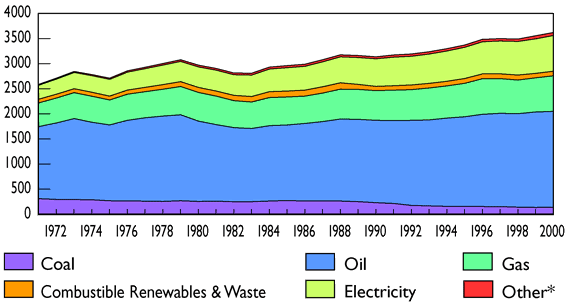
Oil price hikes every week or so are killing me. The direct results of the war in Iraq and the tensions it has released in the Middle East hit you and me right where it hurts. In our pockets. So what are the possible reasons for oil price hikes here and all over the world? Nicolas Sarkis, director of the Arab Petroleum Research Centre and editor of ’Le pétrole et le gaz arabes,’ explains in this article.
Its probably already a well-known fact Big Oil interests are very much in play on the Iraq war, among other things. At present it outrages us, the very audacity and greed of Big Men in Power. The long-term effects? We shouldn't kid ourselves. Its bad in the Philippines, and whats happening outside of its borders will only make things worse.
Here are some very curious things I learned.
"Which energy source will we use in future? Despite forecasts of a change to nuclear power, oil will continue to play a key role. According to the International Energy Agency demand will increase by 1.9% a year, from 80m barrels a day in 2003 to 120m in 2020. By then Arab countries will produce 41% of global supplies rather than the present 25%."
"We should not ignore another grim reality: by 2025 the steep increase in world demand and decline in reserves and output in industrialised countries will increase their dependence on imported oil. US imports will rise from 55.7% to 71%, western European imports from 50.1% to 68.6%, and Chinese from 31.5% to 73.2%. "
"This growing dependence, in a sector as vital as energy, explains the oil wars that the big powers and their companies are waging to gain control of reserves in the Middle East, Africa (3), Central Asia and Iraq (4). There has been serious reason to question the interpretation of the current rises - are they the first sign of a crisis caused by the imbalance between steadily rising demand and inadequate production capacity?"
"The expansion of production capacity over the next few years depends just as much on political stability, particularly in the Middle East, as on the volume of reserves available."
Saturday, August 07, 2004

Genius borders on insanity. This film could never be more clear than this. "Sylvia" is a writer's film. It is moody, slow, depressing, inspiring, stark but vivid. Beautiful. Its a love story between two poets in post-war Britain that ends in tragedy. Infidelity and obsessive love make for incredible poetry.
The Moon and the Yew Tree
Sylvia Plath
This is the light of the mind, cold and planetary
The trees of the mind are black. The light is blue.
The grasses unload their griefs on my feet as if I were God
Prickling my ankles and murmuring of their humility
Fumy, spiritous mists inhabit this place.
Separated from my house by a row of headstones.
I simply cannot see where there is to get to.
The moon is no door. It is a face in its own right,
White as a knuckle and terribly upset.
It drags the sea after it like a dark crime; it is quiet
With the O-gape of complete despair. I live here.
Twice on Sunday, the bells startle the sky --
Eight great tongues affirming the Resurrection
At the end, they soberly bong out their names.
The yew tree points up, it has a Gothic shape.
The eyes lift after it and find the moon.
The moon is my mother. She is not sweet like Mary.
Her blue garments unloose small bats and owls.
How I would like to believe in tenderness -
The face of the effigy, gentled by candles,
Bending, on me in particular, its mild eyes.
I have fallen a long way. Clouds are flowering
Blue and mystical over the face of the stars
Inside the church, the saints will all be blue,
Floating on their delicate feet over the cold pews,
Their hands and faces stiff with holiness.
The moon sees nothing of this. She is bald and wild.
And the message of the yew tree is blackness - blackness and silence.
Thursday, August 05, 2004

Saturday, July 31, 2004
Para sa Gudang at Sa Lahat ng Mga Naninigarilyo

Ako'y nangungulila sa dating samyo ng paborito kong sigarilyo. Tila ba't sa mga nagdaang araw ay nag-iba na ang lasa nito at sa bawat hithit, ako na'y nagkukulang. Dati'y anong namnan, anong sarap ang laruin ito sa pagitan ng aking mga labi. Ang tamis na humihinang, nananatili.
Ang upos na itatapo'y katumbas ng panandaliang ligayang naramdaman sa pagkalinga nito sa aking mga daliri. Dalawampung minuto ng katahimikan, ng pagninilay-nilay, tangan ang aking sigarilyo. Ito'y kaibigan sa pag-iisa, kadaupang-palad na walang sumbat na nagdudulot ligaya. Kahit sandali.
Ngunit ngayo'y tila na ito'y ibig magpaalam. At tila ba'ng ipinagtatabuyan ng aking panlasa, ng aking katawan. Marahil siguro'y ang pangangailanga'y di na katindihan. Ang kalungkuta't pag-iisa ngayon ay napunan. Marahil sa kalaunan ng panaho'y ang tamis ng sigarilyo ko'y manunumbalik. At magdudulot ng panandaliang aliw. Kung kailan man may kailangan.
Friday, July 30, 2004
The US election campaign has begun in earnest starting with the Democratic Conventions this week. I am not an American, and I am not voting come November. But I hope to God a Democrat wins. The rest of the world usually fares better.
Here's Former President Bill Clinton's speech last monday, July 26. It reportedly "brought down the house." Lets see the Republicans top that.
Here are some of the highlights:
After 9/11, we all wanted to be one nation, strong in the fight against terror. The president had a great opportunity to bring us together under his slogan of compassionate conservatism and to unite the world in common cause against terror.
Instead, he and his congressional allies made a very different choice: to use the moment of unity to push America too far to the right and to walk away from our allies, not only in attacking Iraq before the weapons inspectors finished their jobs, but in withdrawing American support for the Climate Change Treaty, the International Court for war criminals, the ABM treaty, and even the Comprehensive Nuclear Test Ban Treaty.
....For the first time ever when America was on a war footing, there were two huge tax cuts, nearly half of which went to the top one percent. I’m in that group now for the first time in my life.
When I was in office, the Republicans were pretty mean to me. When I left and made money, I became part of the most important group in the world to them. At first I thought I should send them a thank you note—until I realized they were sending you the bill.
They protected my tax cuts while:
· Withholding promised funding for the Leave No Child Behind Act, leaving over 2 million children behind
· Cutting 140,000 unemployed workers out of job training
· 100,000 working families out of child care assistance
· 300,000 poor children out of after school programs
· Raising out of pocket healthcare costs to veterans
· Weakening or reversing important environmental advances for clean air and the preservation of our forests.
...Here is what I know about John Kerry. During the Vietnam War, many young men—including the current president, the vice president and me—could have gone to Vietnam but didn’t. John Kerry came from a privileged background and could have avoided it too. Instead he said, send me.
Their opponents will tell you to be afraid of John Kerry and John Edwards, because they won’t stand up to the terrorists—don’t you believe it. Strength and wisdom are not conflicting values—they go hand in hand. John Kerry has both. His first priority will be keeping America safe. Remember the scripture: Be Not Afraid.
Tuesday, July 27, 2004

The President's State of the Nation Address yesterday
• The nation's most worrying economic problem is the rising budget deficit. Last year, the actual deficit was P199.9 billion against a target of P202 billion. The target this year is P197.8 billion. In the first semester, the actual deficit was P80.1 billion against a target of P79.6 billion. The nation has been posting budget deficits in nine of the last 13 years.
The ballooning deficit poses a danger to the nation because it stunts the economy, bloats the nation's debt burden, raises interest rates, spurs inflation and, because it is a sign of mismanagement of the nation's finances, turns off potential foreign investors.
• The public debt is increasing; debt service eats up about one-third of the national budget that would otherwise go to essential social services and infrastructure. The government's public debt stock as of September 2003 stood at P3.8 trillion or 90 percent of GDP.
• The country's population, one of the fastest growing in Asia, is expected to break the 84-million mark this year if left unchecked. About three babies are born every minute. The high population growth rate of 2.36 percent negates economic growth, puts pressure on social services and infrastructure and causes overcrowding in the cities.
• The incidence of poverty is growing, from 31.8 percent in 1997 to 33.7 percent in 2000, or 32 million poor Filipinos in absolute terms. The projection is that 40 percent now live below the poverty line.
• The number of unemployed rose to 4.99 million last April. The unemployment rate increased to 13.7 percent in April from 12.2 percent in the same month last year. Every year about 1.9 million Filipinos enter the labor force.
• On the brighter side, the country's gross domestic product grew 6.4 percent in the first quarter, compared to 4.8 percent in the same period last year. It was the country's strongest economic performance since 2001.
• The economy grew 6.4 percent in the first quarter on the back of robust farm output and election spending. Last year the gross national product expanded by a hefty 5.5 percent, spurred by the rapid expansion in remittances from overseas workers.
• The economy is being kept afloat by the remittances from an estimated seven million overseas Filipino workers, which is projected to increase to about $8-9 billion this year from $7.6 billion last year.
• The agriculture sector grew by 7.7 percent in the first quarter, compared to 2.9 percent in the same period last year. The services sector, the fastest expanding sector in 2003, grew by 5.9 percent.
• Merchandise exports in May rose by 15.3 percent to $3.26 billion, the highest in 18 months.
• Total investments in the first five months of the year rose 692 percent to P137.4 billion from only P17 billion in the same period last year.
Subscribe to:
Posts (Atom)