Thursday, November 08, 2007

Save Marilou Ranario

Please take a moment of your time to sign the online petition addressed to the Kuwaiti Emir to pardon Marilou Ranario. She has been sentenced to death for the murder of her employer in 2005. Court hearings are currently ongoing and a final decision is expected by January or February next year.

From Bulatlat, some of the abuses Filipinas must suffer to provide for their families back home:
As a domestic worker, Rosebelle used to work from 4 a.m. up to 2 a.m. everyday. She barely had two hours of sleep daily, and had no day off. “Bawal umupo, tuluy-tuloy ang trabaho,” (I was not allowed to even sit down. I had to work continuously.) complained Rosebelle, adding that there was also not enough food to give her overworked body the strength for the whole day. She said she was allowed to eat only at 3 p.m., if there is left-over food. She said she survived on the biscuits that she brought from the Philippines otherwise she could have died of starvation.

In only a year in Kuwait, Angel, not her real name, had four employers.

Though she did not experience being beaten up in her 11 months of working with her first employer did not mean that she was treated any better, she said. Instead of giving her the left-over food, she said, her employer would take them all to their room upstairs. The left-over food would be left to spoil up to the next day, she said regretfully. She was not given any food and was also not allowed to go to the grocery to buy for her personal needs.

She was also prohibited to have a cellular phone. It was a problem for her because she had no means to inform her parents that she had remitted money or about her conditions there.

Because of these, she had an unpleasant relationship with her employer. She was sold to other employers. With her second employer, she was the only one doing the chores in a big house, plus taking care of the five children. Despite the workload, she was not fed at all.

Tuesday, November 06, 2007

Protest Against Panggagago

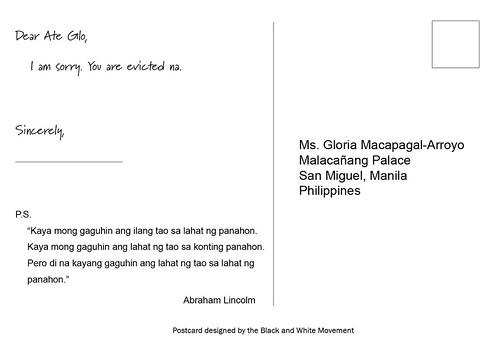
Via Manolo, the Black and White Movement is arranging a mass post-card sending event on Friday, November 9 at the post office. They're also planning simultaneous symbolic gestures in key cities with Diasporic communities.

Again a minor caveat on this movement's slogans, I don't know if they are being self-consciously bourgeois (and thus inclusive) or they're making fun of the apathetic middle class. See, the message behind the postcard below:


Remember I didn't like their slogan "Patalsikin na, now na!" in previous mass actions. But really, this is just piss-poor translation of Lincoln's quotable quote. Sheesh. I humbly propose a better one, without (hopefully) losing the oomph:

Kayo mong linlangin ang lahat ng mga mamamayan sa ilang pagkakataon at ang ilan sa kanila sa lahat ng pagkakataon, ngunit 'di mo kayang gaguhin ang lahat ng mga mamamayan sa lahat ng pagkakataon.

ETA:

Hehe, thank god the Pinoy Big Briber movement made some modifications to their translation.

Monday, November 05, 2007

Economia by Geoff Davies

Geoff Davies, geophysicist, on reviving the corporate contract:

"Commerce is not possible without an ordered and healthy society. Corporations exist because society created them and allows them to exist. Corporations are intended to facilitate certain kinds of commerce, which are intended to serve the interests of people and society…The social contract between corporations and society needs to be revived and redrawn. Ultimately, society owes corporations nothing, since corporations are creatures of society, created to further the public interest…Wealth is generated by a confluence of knowledge, initiative, effort and money…Yet in our economic system wealth accrues primarily to those who provide money. Those who provide knowledge and effort are regarded as a burden rather than as vital contributors, and paid as little as possible…Thus in our system wealth accrues primarily to owners and senior managers, and the main conduit for their rewards is the corporation (p. 175)."

Sunday, November 04, 2007

Mahirap...

...ang aburido. :( Grrrrrrrrrrrrr.

Monday, October 22, 2007

Jo Koy

Filipino-American comic Jo Koy wears his heritage proudly on Jay Leno.

The Story of Our Country?

Pasensya na puro quotes na lang ako sa mga binabasa ko. Mahirap ang semester na'to kaya walang panahong magsulat for leisure.

May minsang nagtanong sa'kin kung bakit mas gusto ko ang IPE (International Political Economy) kaysa sa mainstream IR (International Relations). Napa-isip tuloy ako. Oo nga naman, bakit kaya? Ang IR kasi sinasagot ang mga tanong nga kung ano ang pinagmumulan ng digmaan sa pagitan ng mga bansa. So ang pinag-uusapan dito kung paano pigilan ang conflict, paano mapapaigiting ang kapayapaan. Medyo "masculine" ang mainstream IR kasi puro security issues ang mga paksa.

Ang IPE ang tinatanong - Paano yayaman ang bansa mo sa isang mundong tumatakbo sa sistemang kapitalista? Ano ang koneksyon ng nangyayari sa loob ng bansa at sa mga nangyayari sa abroad? Meron ba'ng connect? (Naturalmente meron) Ano ang koneksyon ng pulitika at ang paglikha ng yaman (wealth creation)?

Since wala naman tayong kaaway kundi sarili natin, ano nga ba naman ang logical na pagka-intersan ko?

Hemingway, pagdamutan ninyo ang talatang ito mula kay Barry Clark - Political Economy A Comparative Approach:
Because government can supersede the market’s distribution of income, citizens may attempt to use governmental authority to benefit themselves. Moreover, this process often becomes self-reinforcing.

As some individuals or groups gain benefits from government, other citizens conclude that money flows to power, and power requires organisation. Interest groups proliferate and demands on government intensify.

This politicisation of the economy may contribute to disorder in two ways. First, productive resources are diverted to the political struggle for control of government, resulting in slower growth and reduced competitiveness. Second, when government becomes a major determinant of individual success in a society lacking consensus about social justice, resentment toward government erodes support for public authority.

Citizens perceive government as s imply a tool with which some groups maintain privileges at the expense of others. The combination of a sluggish economy and political alienation results in social disorder (Barry 1998: 15).
Hindi dapat ganito pero ganito ang katotohanan ng Pilipinas ngayon. Ang malaking tanong, hahayaan na lang ba natin magpatuloy ito? Ano? Aalis na lang ba tayong lahat? Maglilipana sa kung saan-saang dako ng mundo?

Ang tanong ko sa mga estudyante ko nu'ng isang taon bago ako umalis - bombahin na lang kaya natin ang Pilipinas at nang lumubog na sa Pacific Ocean? Tapos lahat tayo refugees...E di tapos ang problema 'di ba? Nagtawanan ang mga estudyante ko. Absurd nga naman ang tanong. Pero matapos ang hagalpakan - isa-isa silang nagbigay argumento kung bakit hindi dapat sumuko. Parang panatang makabayan ang dating ng mga litanya nila....

...Iniibig ko ang Pilipinas. Ito ang aking lupang sinilangan...ito ang tahanan ng aking lahi.....

Friday, October 19, 2007

Glorietta Blast (Updated)

Citizen journalists upload some footage.

An anonymous user uploaded this on Google Video:


From inthethickofthings on YouTube:


From verin18 on YT:


From partyphiliac on YT


See updates at the Inquirer Site. Also check out Manolos' blog roundup.

Updates:

All hail the camera phone! This is a "video scoop" on the GMA news website. It looks like another citizen took some footage inside the mall immediately after the explosion.


For the latest Philippine news stories and videos, visit GMANews.TV

From tonyocruz on YT:

The Story of Our Lives?

I have never read it put so succinctly, but isn't this the story of our lives? From William Lazonick's Business organization and the myth of the market economy:

When an individual invests in the development of his or her productive capabilities, he or she may expect to reap returns in the form of stable and remunerative employment that will permit a decent standard of living over a period of some forty to fifty years.

For many individuals, such economic security represents the foundation for the achievement of other goals such as work satisfaction, luxury consumption, and social mobility for themselves or their children. Through inheritance, gambling, theft, extortion, speculation, and so on, individuals can reap where they have not sown. But for most people in a capitalist society, the development of productive capabilities is a prerequisite to stable and remunerative employment, which is in turn the primary means to achieve personal goals.

Thursday, October 18, 2007

Satanic Mills or Silicon Islands?

Trawling the internet...I stumble across Satanic Mills or Silicon Islands: The Politics of High-Tech Production in the Philippines.

Please find an excerpt chapter here.

Thankfully, this books is locally available in the Ateneo Press.

From a book review by Jane Hutchison:

McKay starts with a detailed account of the history and structure of the electronics industry in the Philippines. In essence, the industry was established in the early 1970s, but did not take off as the leading source of national exports until the mid-1990s, after there was a significant change in state investment policies on the ownership and operation of export processing zones (EPZs).

World Bank reports have commented very favourably on the technical sophistication of Philippine exports due to the expansion of the electronics industry; however, McKay cover§ the negatives as well - the high concentration in semiconductor assembly and testing phases, a lack of forward and backward industrial linkages and the resultant, strong dependence on imports of inputs.

As local value-added is overwhelmingly labour-based, it is not a surprise that multinational firms are attracted to the Philippines by the quality of its English-speaking workforce. But in addition to these national attributes, McKay stresses the significance ofthe emergence ofa new generation of smaller, privatised EPZs as "stateof-the-art" enclaves for electronics investment. He argues these mark a new era in the political economy of industrial development ih the country because they entail a shift to a "regulatory" state form which is characterised by interventions to shield corporate interests from social and political forces.

Tuesday, October 16, 2007

Quo Vadis Democracy?

It took over two weeks, but my book on Democratisation has finally arrived! Bless you Booktopia for importing this all the way from the US with no extra charge to me. I first encountered Jean Grugel's seminal work while doing a grad class on Democracy a few years back. The core ideas I took away from reading one chapter was that political plurality can be reached through compromises between competing power groups. The "compromise" may not necessarily be reached through non-violent means however, as history will attest to (think French Revolution).

What most people neglect to remember is that political plurality means nothing without economic plurality, as our own experience has shown us. What do you do with political independence when you cannot even guarantee a minimum of socio-economic independence. The classic critique against our so-called democracy is, "Can you eat your right to vote?" We all agree that our public institutions have not been in the service of the public good (however we choose to define the term). Our public institutions are corrupt - corruption being a symptom of an unfinished democracy.

Last I checked this book could not be found in UP, ADMU or DLSU's library collection, which is a real pity. In any case, I'll see if I can come up with a book review once I finish reading the whole thing. In the mean time, here is an excellent overview of what this book is about. The items underlined and in bold are my own emphasis. From the Introductory chapter of Democratisation: A Critical Introduction, Jean Grugel writes:

This book analyses one of the most exciting developments in contemporary politics: the sustained attempts, which have gradually gathered pace since the 1970s, to subject government to popular control and to make states work in ways that favour the broad mass of the people. Struggles to establish democracy have their roots in the belief that everyone deserves to live in conditions of dignity, tolerance and respect. This book explains how a range of global pressures and events combined to open a political opportunity for democratisation at the end of the twentieth century. It also analyses the fate of some experiments in democratisation.

In brief, it presents the view that, despite the range of global pressures for democratisation, the consolidation of democratisation is nationally determined. Where democratisation is successful, it is due to two factors, namely the emergence of a strong, dense and vibrant civil societies that work consistently to democratise politics and to hold the state accountable, and the existence of a capable and flexible state....

....democratisation is a slow and painful business. Elite commitment to democracy can weaken and is often contingent; structural factors frequently impede the deepening of democratisation; and globalisation can be as much an obstacle as an assistance....the creation of democracy is a radical and challenging business, during which groups with interests embedded in the maintenance of the non-democratic status quo have to be either defeated or reformed.

The question we can now all ask ourselves is this - where is our democracy going? And how will we get there?

Monday, October 15, 2007

Looking Back to See the Future

Over three years ago I suggested Filipinos were the first Iraqis. Trawling the internet on current debates over IR theory, I stumble into the familiar names of Anna Agathangelou and LHM Ling. They write:
Liberalism fails postcolonial states. Its social ontology of fear and property necessarily alienates the Other, whether embodied in an individual person, a society, or an institution of power like the state. Along with class, this alienation carries connotations for race, gender, and culture as well. We find echoes of the current war in Iraq, for example, in the US annexation of the Philippines in 1898 not just in terms of military violence, political manipulation, and economic exploitation but also ideological rationale.

Please find the rest of this working paper here.

World vs. Bank


At 9:00 am Central European Time (5pm here and 3pm in Manila), those with precious free time and broadband connection might want to witness a public hearing of the World Bank's poverty alleviation policies in the developing world.

Lidy Nacpil of Jubilee South Philippines will be one of those who will give the opening address.

Hopefully we'll be able to access the live streaming of this rare event here or here.

From the Bank Information Centre:

The Tribunal's jury will analyze two policy ‘cases’ of the World Bank: economic conditionalities and the funding of extractive industry projects. As in the recently held Independent People's Tribunal on the World Bank in India, the European Tribunal will hear from witnesses from Southern continents who will give testimony of the impacts of World Bank policies and practices, especially in the areas of conditionalities and fossil fuel project funding. The hearing will also serve as a "forum for a debate on the future of the World Bank, the current development model and potential alternatives."

The Programme

9.15-9.45

Introduction

Overview of the history of the World Bank with reference to the Tribunals in 1988 and 1995, and the reasons for this Update Hearing

Lidy Nacpil (Jubilee South, Philippines), Antonio Tricarico (CRBM, Italy)

9.45-10.00

Artist presentation

10.00-16.00

Testimonies

Testimonies on the impact of privatisation, liberalisation and fossil fuel project funding with questions from the expert panel

Witnesses

Gonzalo Salgado, National Consumer Defence Network, Nicaragua

Miguel Palacin, CONACAMI Peru

Collins Magalasi, Action Aid Malawi

Temo Tamboura, CAD Mali

Svetlana Anosova, Berezovka Initiative Group, Kazakhstan

Michael Karikpo, Environmental Rights Action/Friends of the Earth Nigeria

Expert Panel

Maartje van Putten, Former member of the World Bank Inspection Panel

Francesco Martone, Senator, Italy

Marcos Arruda, TNI and PACS Brazil

Medha Patkar, Founder of the National Alliance of People's Movements, India

Charles Abugre, Development Economist, Ghana

16.00-16.30

Video interview

Video interview with Bert Koenders, Dutch Development Minister

16.30-17.00

Concluding remarks

Concluding remarks and looking forward by the President of the Expert Panel

17.00-18:30

Reception

With music from the Philippines

Thursday, October 11, 2007

Scammer Nation?

Ranting to Up Dharma Down, Corinne Bailey Rae and Robin Thicke

Banality: The Postindustrial Disease

Ranting to Mazzy Star

Monday, October 01, 2007

Week Four

Just letting you all know I'm still alive, but running out of steam I think. I know I'm not here on vacation, but the feeling of not having any purpose is starting to get to me. I want to go home and soon.

It is week four of my third semester. There's still Christmas and New Years a few more months then its all over. I'm not on vacation I know, but some enjoyment wouldn't hurt. But I'm antsy and impatient and useless in Australia. I'm almost done Manila...Konti na lang.